Introduction
In a competitive marketplace, fostering customer loyalty is essential for sustained business performance. The apparel industry, especially premium men’s wear, depends on consistent repeat business for growth. Raymond, with a legacy of nearly a century, represents quality and sophistication in the Indian context. The present study investigates how brand perception and product quality influence customers’ intent to repurchase from Raymond stores.
Strengths, Weaknesses, Opportunities, and Threats (SWOT) analysis
Strengths
1. Strong brand equity with 90+ years of legacy.
2. Wide product portfolio: textiles, apparel, ethnic wear, home décor, hygiene.
3. Vertically integrated, ensuring cost efficiency and quality.
4. Innovation with new collections (e.g., Techno-smart, Virasafe).
Weaknesses
1. Premium pricing limits mass-market reach.
2. Smaller digital presence vs. newer D2C brands.
Opportunities
1. Rising demand for ready-to-wear apparel.
2. Growing trend toward sustainable, eco-friendly fashion.
Threats
1. Intense competition (Siyaram, Aditya Birla, etc.).
2. Shift in consumer preference toward casual wear impacting the suiting segment.
Literature review
Refer to Table 1 for additional information.
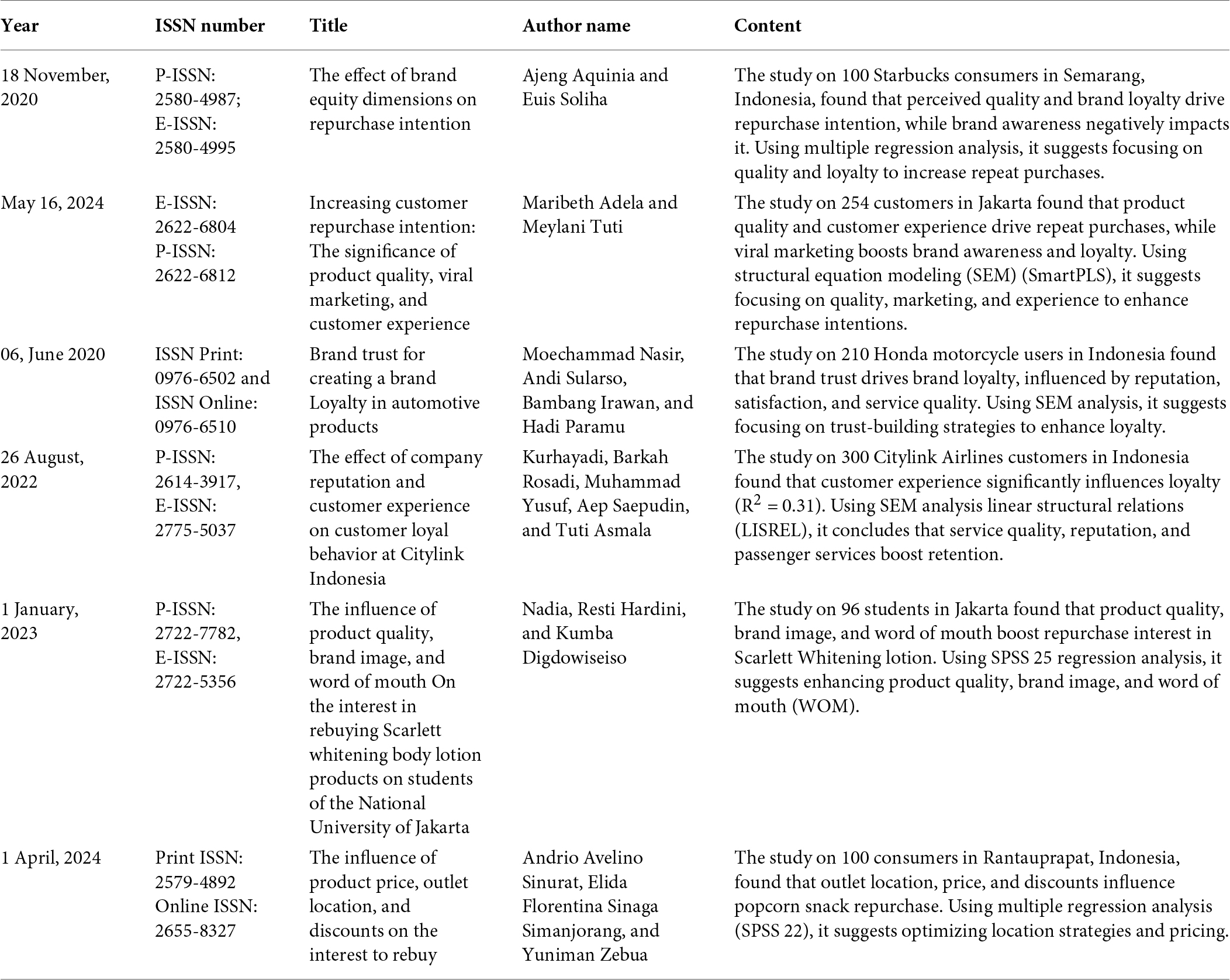
Table 1. Summary of literature review.
Previous studies confirm that brand image, perceived quality, and trust significantly influence customer loyalty. Saleem et al. (1) found that brand awareness and perceived quality enhance brand loyalty. Aquinia and Soliha (2) reported that perceived quality has a strong impact on repurchase intention. Baig et al. (3) emphasized the mediating role of customer satisfaction and trust in building brand loyalty. Chauhan (4) also highlighted that trust and satisfaction are key drivers of repeat purchase behaviour.
Research gap
1. Prior studies have largely focused on industries such as fast-moving consumer goods (FMCG), cosmetics, aviation, and automotive, with limited attention to the Indian premium apparel sector.
2. While factors like product quality, brand trust, and customer experience are established drivers of loyalty, little research has examined their role in premium men’s fashion, particularly for Raymond.
3. Moreover, demographic influences, digital engagement, and changing consumer preferences remain underexplored, creating a gap that this study addresses by analyzing the effect of brand perception and product quality on customer loyalty in Raymond’s context.
Objective and hypotheses
Main objective
1. To examine the effect of brand perception and product quality on customer loyalty in the context of Raymond.
2. To assess how product quality impacts repurchase decisions with demographic influence on customer loyalty.
Variables considered for the research
Brand perception refers to how customers interpret a brand’s value through their experiences, word-of-mouth, and marketing efforts (5). A favorable perception builds emotional connection and purchasing confidence. For Raymond, heritage, design quality, and consistent branding drive strong perception.
Brand trust
Brand trust is the confidence customers place in a brand’s reliability and intentions, developed through consistent performance and positive brand experiences (6). It develops through consistent product performance, honest communication, and long-term satisfaction. Raymond earns trust through dependable service and high-quality offerings.
Product quality
High product quality is essential for customer satisfaction and repeat buying, as perceived quality strongly influences brand loyalty and repurchase intention (1, 5). In Raymond’s case, excellence in fabric, tailoring, and personalized service contributes to its premium quality image.
Customer loyalty
Customer loyalty is a buyer’s repeated preference for a brand despite alternatives and is influenced by trust, satisfaction, and emotional attachment (3, 4). It includes:
Attitudinal Loyalty: emotional attachment and brand advocacy.
Behavioral Loyalty: frequent repurchasing.
Loyalty in Raymond’s customers stems from trust, satisfaction, and brand alignment.
Keller’s customer-based brand equity (CBBE) model
Keller’s model identifies four stages of brand-building:
1. Salience: brand awareness
2. Performance and Imagery: product quality and brand associations
3. Judgments and Feelings: evaluations and emotional responses
4. Resonance: strong loyalty and advocacy Raymond achieves resonance through trust and premium position.
The loyalty ladder framework
This model outlines the customer’s journey from awareness to advocacy: Suspect → Prospect → Customer → Repeat Buyer → Loyal Supporter → Brand Advocate.
Raymond’s goal is to elevate customers to the advocacy level through quality, experience, and emotional branding.
Refer to Table 2 for additional information.

Table 2. Research design and methodology.
Data analysis and findings
Demographics
Most respondents were male (78%), aged 30–45, employed as professionals or business owners, with middle to high income levels.
Key results
1. Brand Trust: 83% of respondents strongly agreed that Raymond is trustworthy.
2. Product Quality: 87% believed Raymond offers superior suiting and formal wear quality.
3. Repeat Purchase Behavior: Over 68% of respondents reported they had shopped at Raymond more than three times in the last 12 months.
4. Promotions: Loyalty programs and in-store offers increased repurchase intention, especially for mid-income customers.
Regression summary
Refer to Table 3 for additional information.

Table 3. Variable analysis.
Interpretation: Brand trust and product quality are statistically significant predictors of repeat purchases. Emotional factors and perceived value enhance this relationship.
Factor analysis summary
Refer to Table 4 for additional information.

Table 4. Results of factor analysis.
The factor analysis confirms that product-related variables (such as variety, quality, innovation, and fit) significantly outweigh promotional or social influences in repeat purchasing behavior. These findings reinforce the importance of maintaining product excellence and innovation in customer retention strategies.
Conclusions and implications
The study affirms that brand perception and product quality are central to fostering customer loyalty at Raymond. Trust, emotional satisfaction, and personalized service are major retention levers. While Raymond holds a strong market image, improvements in digital engagement, competitive pricing for broader accessibility, and loyalty program expansion are recommended.
Managerial Implications:
1. Enhance Customer Relationship Management (CRM) systems to personalize offers and increase engagement.
2. Strengthen digital presence through e-commerce and influencer collaboration.
3. Introduce tiered loyalty rewards to maintain high-value customers.
4. Periodic feedback collection to align branding with customer expectations.
Moreover, the loyalty of customers is not static; it evolves over time as customers interact with the brand across various touchpoints. In Raymond’s case, these include the in-store experience, customer service, fabric innovation, and seasonal offers. As competition increases with the emergence of online-first brands and direct-to-consumer fashion lines, it becomes critical for Raymond to not only retain its loyal customers but also convert first-time buyers into repeat purchasers. Loyalty programs that offer personalization, exclusive access to collections, and tailored pricing can significantly influence brand commitment.
Customer testimonials and user-generated content can also serve as a tool to reinforce brand trust, especially among younger consumers who rely heavily on peer validation. In parallel, social media engagement through curated content, influencer tie-ins, and interactive campaigns should be emphasized to sustain awareness and emotional appeal.
Stages of the model
Refer to Table 5 for additional information.

Table 5. Independent variables affecting customer loyalty.
Furthermore, it is recommended that Raymond invest in data analytics to better understand customer behavior, purchase cycles, and product preferences. This will enable the brand to forecast demand more accurately and design marketing campaigns that align with seasonal and regional preferences. By leveraging digital tools and focusing on service excellence, Raymond can continue to thrive as a benchmark of loyalty-driven branding.
Refer to Figure 1 for additional information.

Figure 1. Brand perception to repeat purchase cycle.
Funding
The authors declare that this research received no external funding.
Conflict of interest
The authors declare that the research was conducted in the absence of any commercial or financial relationships that could be construed as a potential conflict of interest.
References
1. Saleem S, Ur Rahman S, Umar RM. Measuring customer-based brand equity. Int J Market Stud. (2015) 7(1):1–10.
2. Aquinia A, Soliha E. Brand equity and repurchase intention. Indones J Marke Res. (2020) 3(2):97–103.
3. Baig SA, Zia-Ur-Rehman M, Saud Javed E, Aslam T, Shafique A. Customer satisfaction and trust in brand loyalty. J Contemp Market. (2015) 3:1–13.
5. Keller KL. Conceptualizing, measuring, and managing customer-based brand equity. J Market. (1993) 57(1):1–22.
6. Chaudhuri A, Holbrook MB. The chain of effects from brand trust and brand affect to brand performance. J Market. (2001) 65(2): 81–93.
© The Author(s). 2026 Open Access This article is distributed under the terms of the Creative Commons Attribution 4.0 International License (https://creativecommons.org/licenses/by/4.0/), which permits unrestricted use, distribution, and reproduction in any medium, provided you give appropriate credit to the original author(s) and the source, provide a link to the Creative Commons license, and indicate if changes were made.