Dear Editor,
Minor head injuries from road traffic accidents (RTA) are very common in the alcoholic patients presenting to emergency and trauma centers. This significantly adds to the everyday problems that emergency residents encounter, compounding the already existing heavy workload and stress in the emergency and trauma center. It puts an enormous burden on the healthcare institutions and exhausted medical staff, who must deal with these frequent situations in addition to other severe emergency and trauma patients. Incidence rates of such injuries among this specific patient group range from 46% to 65% (1). In clinical practice, many bodily indications help with triage, early diagnosis, and prompt intervention. For example, Levine’s sign (a clenched fist pushed on the chest) is generally recognizable in patients with myocardial ischemia, as reported by American cardiologist Samuel A. Levine (2).
These signals are very useful in directing rapid medical choices and prioritizing treatment. A thorough study of the available medical literature indicates no distinguishing characteristic crossed forearms over chest postural sign in alcoholic patients with mild head traumas. Such a sign has the potential to significantly improve triage efficiency, especially in hectic and resource-constrained emergency rooms.
While signs such as Battle’s sign (bruising over the mastoid process) for basilar skull fractures, Cushing’s triad (hypertension with irregular respiration and bradycardia) for increased intracranial pressure, and the Mount Fuji sign [indicative of pneumocephalus on noncontrast computed tomography (NCCT)] (3–5) have been described in head injury cases, none are specific to alcoholic patients with minor head injuries [Glasgow coma score (GCS) between 13 and 15]. These current indicators either need the use of particular diagnostic instruments or are seen in more severe instances, limiting their usefulness in swiftly diagnosing small injuries in a subset of patients.
During the management of emergency trauma cases at Baba Raghav Das (BRD) Medical College’s Emergency and Trauma Centre in Gorakhpur, India, we noticed a specific crossed forearms over chest postural indicator among alcoholic patients aged 17–30 years who presented with mild head injuries. These patients had a GCS of 13–15, an alcoholic aroma in their breath, stable vitals, and a distinctive posture: crossed forearms put across the chest or belly (Figure 1). Informed written consent was taken from the patient’s close family member for using the image for educational and publication purposes without revealing the patient’s identity. I recommend dubbing this postural sign as P.U. sign. This characteristic particular position was persistently present across these patients, making it a valid predictor of small head injuries in this particular cohort.
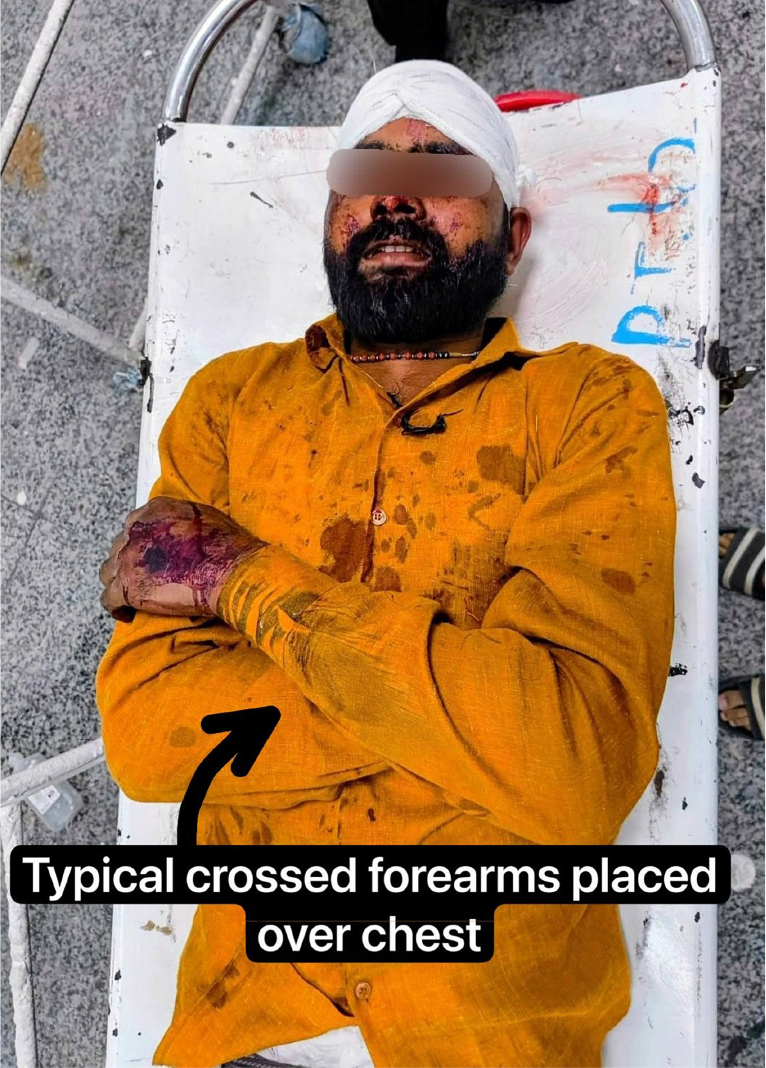
Figure 1. Alcoholic patient with minor head injury showing characteristic crossed forearms over chest postural sign while presenting in ER on stretcher.
Radiological examinations (NCCT head) of such individuals typically yielded no significant Intracranial bleed. These patients were kept under observation for 24–36 hours, and any lacerations were stitched under local anesthesia. They don’t have any associated chest and upper extremity injury or fracture. Most were discharged within 36 hours of admission after regaining full consciousness, with symptomatic prescriptions (e.g., for headache, vomiting) and information on warning signals of head injuries (e.g., loss of consciousness, persistent vomiting, seizures, bleeding from ear and/or nose, weakness in limbs). A repeat NCCT head was done for each patient before discharge, and it doesn’t show any signs of delayed hemorrhage or any other significant finding (like delayed cerebral edema).
Over the 1 year of duration, around 50 such alcoholic patients with minor head injury presented at the trauma center with the similar specific postural signs. Initial and repeat NCCT Head came to be normal in all cases.
P.U. sign has the potential to be used in triage as a bedside diagnostic tool, especially in resource-constrained settings in low- and middle-income nations where NCCT is not widely accessible. This sign may help save time in the emergency room by allocating hospital beds and resources more efficiently to more severely wounded/injured patients. It also gives medical professionals a simple but efficient means to swiftly evaluate and prioritize treatment, which is critical in settings with large patient numbers and limited screening and diagnostic equipment.
Further, more study with a large sample size is required to establish this sign’s clinical value. A prospective research study evaluating P.U. sign’s sensitivity, specificity, and predictive value might give strong evidence for its use in clinical practice. Training emergency professionals to detect and use this indicator may improve patient outcomes by allowing for quicker and more accurate triage in resources limited settings.
Ethical statement
Not Applicable, Appropriate consent taken by the family member (legal gaurdian) for the use of clinical image for educational and publication purposes without revealing the patient identity.
Author contributions
PU: Conceptualization, manuscript drafting, data collection, literature review. AG: Study supervision, critical review critical review of research proposal and final manuscript, final manuscript approval. All authors read and approved the final manuscript for submission and publication.
Funding
This research did not receive any grant or funding from any agencies in the public, commercial, or not-for-profit sectors.
Abbreviations
NCCT Non-Contrast Computed Tomography
GCS Glasgow coma score
RTA road traffic accident
Conflict of interest
The authors declare that the research was conducted in the absence of any commercial or financial relationships that could be construed as a potential conflict of interest.
References
1. Easter JS, Haukoos JS, Claud J, Wilbur L, Hagstrom MT, Cantrill S , et al. Traumatic intracranial injury in intoxicated patients with minor head trauma. Acad Emerg Med. (2013) 20(8):753–60. doi: 10.1111/acem.12184
2. Verelst S, Moonen PJ, Desruelles D, Gillet JB. Emergency department visits due to alcohol intoxication: characteristics of patients and impact on the emergency room. Alcohol Alcohol. (2012) 47(4):433–8. doi: 10.1093/alcalc/ags035
3. Matsumura K, Yamamoto R, Namiki J, Takemura R, Sasaki J. Cushing index based on cushing signs to predict in-hospital death and early intervention for minor head injury. J Neurotrauma. (2023) 40(19–20):2110–7. doi: 10.1089/neu.2022.0424
4. Wu SC, Rau CS, Kuo SCH, Chien PC, Hsieh HY, Hsieh CH. The reverse shock index multiplied by Glasgow coma scale score (rSIG) and prediction of mortality outcome in adult trauma patients: a cross-sectional analysis based on registered trauma data. Int J Environ Res Public Health. (2018) 15(11):2346. doi: 10.3390/ijerph15112346
5. Niknejad M. Mount Fuji Sign. Radiopaedia.org (n.d.). Available online at: https://radiopaedia.org/cases/mount-fuji-sign-7?lang=us (Accessed January 13, 2025).
© The Author(s). 2026 Open Access This article is distributed under the terms of the Creative Commons Attribution 4.0 International License (https://creativecommons.org/licenses/by/4.0/), which permits unrestricted use, distribution, and reproduction in any medium, provided you give appropriate credit to the original author(s) and the source, provide a link to the Creative Commons license, and indicate if changes were made.