Introduction
Social media is one of the most famous tools that can be used by many users today to fulfill many daily needs. According to that, many sites that are related to social media can provide a lot of advantages and disadvantages to the users today, such as WhatsApp, Facebook, Instagram, TikTok, and Snapchat. Social media plays a big role in the daily activities of users today (1). There has been many researches conducted related to social media; according to that, nearly 4.9 billion active users are using social media today for their daily usage and other purposes. Today most of the users need a digital as well as an interactive environment that is needed to connect with others without any troubles. And also there is a need to use the information in the format of text as well as picture and video as well as audio to make connections between the peer groups as well as society, personally as well as publicly. It is very much needed to get the information that is related to local and foreign affairs; according to that, social media plays an important role in providing platform to get those updates regularly and live. Also, the aid of social media can keep many relationships local as well as foreign, and also many mental relaxations can be derived by the use of social media. It also provides an important role to keep in contact with very important people and send feedback to them. Also, there is much information related to many sectors, like education, medical, etc., can be discussed in the important matters related to each field.
Main objective of this paper is to assess the impacts that are related to the social media and mental health positively and negatively. There are many positive and negative impacts can be had by the use of social media, many issues can be formed that are related to the mind as well as can have lot of advantages by the use of it. According to the negative effects, a user can feel afraid of doing everything, stressed, and think they can’t do anything, feel like a lone figure in every situation at work, and, as a result, be affected by the use of social media (2, 3). According to many analyses, many people who are in the stage of teenage and adulthood are mostly facing a lot of issues with the use of social media. Social media can provide a platform to make bond between many communities that can keep good relationships with each other and chase away the negative feelings.
By the use of existing literature from many fields, like psychology, psychiatry, and the field that has interaction between humans and computers. Also, by using theories such as uses and gratifications and social comparison, which were important for examining different types of usage patterns.
According to this review, this paper aims to provide much information that is related to social media, which is one of the important things to provide advantages to the users as well as disadvantages too in many ways. And also, social media and mental health are related, as well as the problems that can be faced by using social media in this current situation, as well as future directions that can be able to give the solutions to the problem related to the use of social media.
In conclusion, social media very much needs an approach in balanced manner and there is a need for using artificial intelligence (AI) as well as an ethical design that is important to protect the mental well-being of the user as well. And also it is providing a better solution to use social media in an effective and efficient manner according to the current situation.
Background and theoretical models
According to the use of the theory of gratification, their applications can be able to give the insights about the people who are using the social media to meet the needs of psychology that are very important to give relaxation to the minds of the people, like fun and joy, as well as the need of thinking, like being in a community, as well as to use healthy methods rather than unhealthier desires. By the use of the theory of comparison, they can be able to do comparisons between the individuals themselves with others (4). With the help of the theory of social comparison, we can explain about the effects of it. Some people get poor self-esteem as well as feel like they are not worthy and also, by seeing others’ pictures on social media, think about their body structure as bad and get not satisfied with their own structures through social media like Instagram or Facebook (5). And also, there is a model of cognitive behavior that can find the emotional behavioral system in problematic social media.
Additionally, the recurrent use of social media by users may lead to addiction to using it again and again. By this users can be affected mentally, according to the hypothesis, which can provide the understanding about why the social media can be affected by the users mentally as well as how it affects (6). By the use of the theories that have been illustrated above, one can easily get the insights about the effects of social media on mental health.
Methodology
This review has been conducted through the existing literature that is related to the ways in which social media is used as well as the mental well-being of using social media in every user’s life. There are important data for this review that have been collected through the research papers, journals, and articles, and also the databases that contain the data related to the review from Google Scholar, IEEE Xplore, and also PubMed and we have spent three months to collect these papers related to this topic. Also, according to this paper, it has the analysis of data between the period of 2013 and 2023. According to the review paper, there are 150 papers that have been collected but 19 are related to this. Also, by the use of the thematic approach, we are able to collect the data related to the impacts of using social media in positive and negative ways.
Results or finding
These positive and negative impacts can be illustrated as follows Table 1.
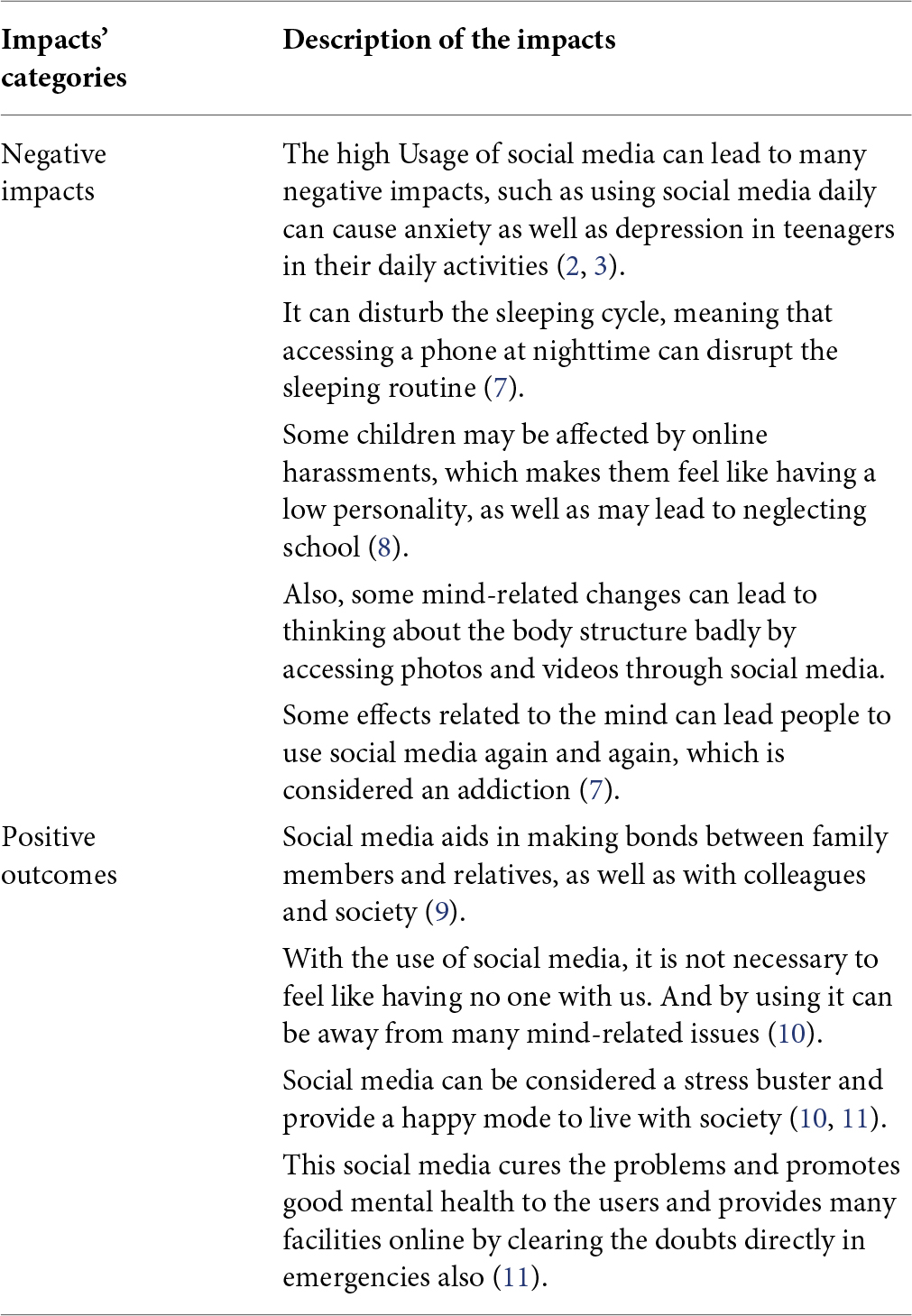
Table 1.
Moderating and mediating factors
Social media can be used to alter people’s perceptions of a specific poll result. Additionally, it is possible to understand unpleasant emotions without harassing others. Additionally, it is possible to utilize the in-line and side-to-side commenting, auto-commenting, and messaging features. These elements also enable them to control one another with strong relationships (12). Additionally, based on the traits that each individual has with their own enterprises, it indicates that anyone who lacks malice, anxiousness, or low self-esteem can be readily impacted by the effects of social media (13). Additionally, according to social media, the majority of teenagers receive threats through their usage of these platforms due to their presence, the community’s judgment (8), and their ability to make them, which may have an impact on their mental health. Additionally, they can manage each other with solid relationships by using social media. Additionally, social media users with experience were able to determine a person’s cultural heritage and unique background.
Additionally, they were able to recognize the communication techniques of a family member, their cultural engagement and interactions with others, and their emotional state. Through social media, they were able to comprehend everything. They were able to identify one person based on these general features (14). Based on these general criteria, they were able to determine that social media use can have both beneficial and negative effects on people’s social media usage and interpersonal interactions. They were able to identify one person based on these general factors.
Discussion
According to the analysis of the positive and negative effects of social media use, we can gain a great deal of insight into that because social media use allows us to obtain both positive and negative effects, as well as information about how to use it, why we use it, and how we use it. Only then can we obtain the effects of social media. Cyber threats, fear of missing out (FOMO), low self-esteem, and an addiction to constantly using social media are all important factors that can have negative effects on users. These factors can lead to anxiety and depression, as well as unhealthy mental well-being and disadvantages from using social media.
Accordingly, it helps people stand out in society, maintain relationships with community workers and the general public, and make use of mental health information. This also presents a number of difficulties. It implies that excessive use of social media may contribute to depressive symptoms. In light of this, it is necessary to acknowledge that social media plays a significant role in our daily lives and that it has both advantages and disadvantages.
The strength of using this review is to provide an approach in an integrated manner as well as to provide a dual impact related to social media, like positive and negative and to be able to provide a balanced approach.
Also, there are some limitations to this study that can be pointed out, which means it does not use the analysis related to the meta-analysis, and it is a narrative review. Also, this research provides data that is related to self-research, and also, some technology gets outdated fast because adding new features may make it hard to find the features related to the technology. Also, this study mostly focuses on the people who are living in the countries in western areas as well as people from different cultures and behaviors; according to that, the finding of this study may not fulfill the satisfaction to get full results.
It can be implied in accordance with the fact that extensive research is required to gather user behaviors and gain insight into the risky elements influencing people’s use of social media. It is also possible to comprehend the advantages of social media use.
Future research directions
Future study on social media indicates that there are numerous approaches to address how it can impact users’ mental health. Additionally, there are still many gaps that need to be filled to address the issues associated with social media. Accordingly, it is possible to fully understand how users’ mental health can be altered by conducting extensive, long-term research as well as some experimental studies. Concurrent studies can also be used to compare the heavy use of social media. Additionally, there is a need to develop AI in order to identify the risks associated with cyber threats, online harassment, and the negative effects of using online tools. These tools must be safe for users by granting them privacy and the ability to use them in an efficient manner. Additionally, in future research, the platforms that users use must be able to effectively manage their mental health to prevent harm to their mental health. Additionally, there are numerous tools that are crucial for researchers studying the efficacy of digital well-being, such as screen time alerts, content filters, and transparent algorithms that help to manage the behaviors of users who are using online features. These tools can help reduce the effects of social media on mental health by offering safe features, timely reminders, and timely feedback.
In the future, by using a lot of platforms like virtual reality, YouTube, and TikTok, you can be able to get a lot of effects from the teenagers, as well as many people can get advantages through that. Also, can be able to make interaction with communities and people. According to all these, social media is a platform to understand the behaviors as well as attitudes related to the adults and teenagers and can be able to analyze their positive behaviors and can be able to make a good person in the society. According to these, the Western countries have no issues related to comparing non-Western countries related to these impacts.
Conclusion
By the analysis of 19 research papers, we are able to conclude that the usage pattern determines the impacts of social media on mental health. According to that, some drivers are important like anxiety as well as provide danger to the sleep cycle, such as scrolling the screen, as well as behaviors that are related to addiction, which can be shown through this study. Also, using social media can serve as a tool for providing the support of society, as well as a tool to build up a society (9, 10). According to the comprehensive review of all papers, social media use can have both positive and negative effects on users. Negative effects include checking updates frequently, scrolling through the screen frequently, comparing oneself to others and structures, cyber threats, sleep deprivation, depression, anxiety, and loneliness. You may also experience some bodily issues. Additionally, according to the altered photos, people can compare themselves to others, which can make them unhappy and cause unwelcome stress on their bodies. Social media is one of the major platforms that are very beneficial to humans in many ways, and if we use it in a meaningful way, it can lead to positive effects. It also helps create peer groups and facilitates meaningful communication with them. Additionally, it can help people get support for mental health issues, make society safer, and offer assistance offline, based on platforms that can have both positive and negative effects depending on how much and what they use. It is crucial to take into account an individual’s cultural background, age, and emotional well-being controls.
Additionally, it is crucial for people to think about the reasons behind their use of social media before utilizing it. This is because social media can be used in an active way at any time, with features like posting, messaging, and commenting that allow users to interact with other people and online communities. It can also be used passively, allowing users to create a variety of outputs. In conclusion, using social media in equal ways
Additionally, by utilizing AI-related tools that are crucial to designing platforms that are related to users in order to make them healthier, users can stay away from harmful threats, think positively, and collaborate with both technology designers and mental health professionals. Additionally, policymakers must create platforms that are very helpful and have user interfaces that support you in working on them in a perfect and fruitful manner in order to get a safe place.
Funding
The authors declare that this research received no external funding.
References
2. Twenge J, Martin G, Campbell B. Decreases in psychological well-being among American adolescents after 2012 and links to screen time. Emotion. (2018) 18(6):765–80.
3. Keles B, McCrae N, Grealish A. A systematic review: the influence of social media on depression, anxiety, and psychological distress. Cyberpsychol Behav Soc Net. (2020) 23(11):737–48.
5. Fardouly J, Vartanian P. Social media and body image concerns: current evidence and future directions. Curr Opin Psychol. (2016) 9:1–5.
7. Przybylski AK, Murayama K, DeHaan CR, Gladwell V. Motivational, emotional, and behavioral correlates of fear of missing out. Comput Hum Behav. (2013) 29(4):1841–8.
8. Hinduja S, Patchin J. Cyberbullying: Identification, Prevention, and Response. Cyberbullying Research Center (2020).
9. Naslund L et al. Digital technology for social connectedness and mental health: a review. JMIR Mental Health. (2016) 3(1).
10. McInroy C, Craig S. Online interfaces of LGBTQ+ youth: identity and social support. J Youth Stud. (2015) 18(10):1078.
11. Yim J, Schmidt S. Digital mental health interventions in social media environments. Front Psychiatr. (2019) 10.
14. Vaidya M, Pathak R. Cross-cultural differences in social media effects on mental health. Asian J Psychiatr. (2021) 60.
© The Author(s). 2026 Open Access This article is distributed under the terms of the Creative Commons Attribution 4.0 International License (https://creativecommons.org/licenses/by/4.0/), which permits unrestricted use, distribution, and reproduction in any medium, provided you give appropriate credit to the original author(s) and the source, provide a link to the Creative Commons license, and indicate if changes were made.