Introduction
“X” is a private university in the country of Bangladesh. The study commends the 10-Year Strategic Plan (July 2027-June 2037) to improve national compliance and global competitiveness by merging the University Grants Commission (UGC) and Bangladesh Accreditation Council (BAC) Act (2017) standards with global benchmarking standards. Campus education, research, and infrastructure include the implementation of the United Nations Sustainable Development Goals (UN SDGs). Transforming organizational culture in higher education requires structured, yet flexible and inclusive processes, robust governance and capacity training of stakeholders for success (1). To develop a winning plan, the organization needs leadership commitment, intellectual engagement and experience in company culture and change management. The system has to be updated. That is, who are the stakeholders, what are the lines of communication, how to manage opposition, and how to align incentives (2). Nature Index (3) reveals how businesses balance deliberate strategy with emergent change under dynamic situations through strategic planning, management control and organizational behavior. The notion of authority determines adoption of the strategy.
Groups and culture in organizations
Poor countries have bureaucratic structures with intellectual and administrative specialists that desire to develop. But they don’t have good money; approximately 150 US strategic plans in the literature have similar features (4). And that behavior is questioned. Volatility is a pain. McNaughton discussed the 2025 contingency and scenario budgeting. Ali et al. (5) studied the economic productivity and higher education in Bangladesh and advocated international norms and funding. Stakeholder engagement requires a strategic plan (6, 7). Ali et al. (8) showed that the quality of the BAC element was associated with student attrition (9). Strategic plan for institutional effectiveness strategic planning is the process of goal setting, allocation of resources, and goal evaluation with data (10).
Our View: to be the best private university for research, innovation, and excellence in Bangladesh.
TASK: To create responsible professionals, entrepreneurs, and critical thinkers via creative and ethical career-orientated education.
Super Goal: Knowledge, employability and ethics, education for better society, and avoid negativity in organization.
Accreditation-Rankings link the idea produces engines for professional accreditations and international rankings for quality improvement, including Key Performance Indicator (KPI)-based self-studies to decrease redundancy. The confluence offers possibilities for organizational behavior, including faculty adjustment, cultural shifts from teaching to research emphasis, and alignment of individual performance to institutional criteria.
Purposes
• Engineering: Accredited with Accreditation Board for Engineering and Technology (ABET) and Board of Accreditation for Engineering and Technical Education (BAETE).
• Business: AACSB/ACBSP/EQUIS accredited.
• Legal: National Bar compliance, Climate Justice Clinic, international ties.
Milestones (by June 2034) Finalize engineering qualifications Accreditation of Business Schools 100+ high-impact papers per year, 30,000 community beneficiaries Funding diversification [green bonds, Public-Private Partnerships (PPPs), development banks].
Ultimate Horizon June 2037 Top 50 in the world for sustainability-focused Higher Education (HE) roles (totally accredited) Regional Institute for Sustainability Sciences Campus Carbon Neutrality.
Research Questions: How may a private university in Bangladesh construct 10-year integrated plan for national accreditation, world rankings, and long-term existence by effective organizational behavior practices?
Goals:
1. Evaluation of the current national/international quality assurance situation
2. Build a plan on how to implement balanced scorecards and KPIs into operations
3. Roadmap for implementation (Foundation, Transformation, Leadership)
4. Policy implications and additional research
Overview of literature
The review based on Preferred Reporting Items for Systematic Reviews and Meta-Analyses (PRISMA) includes 20 sources on 3 themes:
• Foundations of Strategic Planning (9 resources) Ziemba (11) – clear eyesight, Larche (12) – measurable goals, stakeholder engagement, Begičević Ređep et al. (13) – agile principles, Bogorya (14) and Moran (15) – first theory-practice gap, Aravena et al. (16) – short-term planning restrictions, Menon et al. (17) – top-down requirements Specific, Measurable, Achievable, Relevant, Time-bound (goals) (SMART) mission statements, Krstevska and Bajrami (18) and Buser (19) – connections and resilience.
• Accreditation and Quality Control (7 sources) - Chang (20) - relevance, efficiency, impact, and sustainability, Visagas and Kim (21) – three-phase model, Ali et al. (22) – knowledge management and self-evaluation, Commission on Osteopathic College Accreditation (23) – osteopathic standards, Kayyali (24) – accreditation as a strategic force, Centre for Teaching and Learning (25) – effective philosophies, Preza (26) – technology with critical thinking.
Employability and Skills (4 sources) Hossan (27), Holiday and Abu (28), and Bui et al. (29) – graduate skills mismatches (soft skills, English); Loyalka et al. (30) – English programs raise wages and employability.
The scholarly literature on organizational behavior in HE emphasizes the necessity for preparedness for change (31), psychological safety (32) and democratic decision making (33) to successfully implement the strategic plan. Faculty resistance to performance indicators, especially to accreditation requirements, has been well documented (34). Additionally, the impact of leadership styles (transformational versus transactional) on implementation efficacy in academic settings has been examined (35). Cultural characteristics such as power distance, collectivism, etc. influence organizational dynamics in emerging nations. These elements make Organizational Behavior (OB) approaches culturally relevant (36).
Research gaps:
• Quacquarelli Symonds (QS)/Times Higher Education (THE) signals are poorly linked with BAC compliance.
• Most of the frameworks are contextualized in the western perspective and they are not relevant in the Bangladeshi private universities.
• Very little study exists on the viewpoints of South Asian private HE stakeholders.
• Practical qualitative forms of strategy planning do not include OB aspects.
• There is virtually little study on change management and faculty adaptation within the framework of accreditation in private higher education in Bangladesh.
Implementation Principles: Taking Decisions Based on Data, All the metrics show similar progress: Prioritize quality over quantity of research, Internationalization: conscious of location Change Leadership in Reputation Management Academic Empowerment, Communication Transparency, and Stakeholders Participation.
Organizational behavior focus
The sustainability of the strategy plan in the long run depends on addressing the underlying OB concerns in the private HE sector in Bangladesh: Change Readiness: Training, incentives, and participative decision-making are needed to move faculty and staff from cultures of compliance to cultures of quality innovation. If resistance is to be reduced, then psychological reactions to change (37) need to be understood. Leadership Development: Senior leaders are committed to demonstrating desired behaviors and driving strategic objectives over time. Intellectual stimulation and individualized consideration are the foundation of transformational leadership (38). Cultural shift: From individualistic to collaborative norms, driven by recognition systems and team-oriented rewards. Power Distance: work with participatory government models Resistance Management: proactive communication, inclusion in planning, anxiety about increased workload, loss of autonomy, or performance pressure. Building a psychologically safe environment for innovation and experimentation is essential. Talent Retention: To attract and retain professors with PhDs, salary must be competitive, career paths must be clear, and the work must be intellectually stimulating. Workload and well-being activity management to reduce the danger of burnout Student Engagement: Work together on learning experiences, feedback, and employability support to create loyalty and prevent attrition. Building student-organization identification is essential. Performance Culture: Moving from input to output measurement necessitates smart OB design: explicit expectations, equitable evaluation, constructive criticism, and recognition systems that encourage instead of discourage.
Guidance for upcoming investigation
1. Performance indicators in terms of accreditation as perceived by the academic members of private universities of Bangladesh.
2. Readiness for transformation models in HE environments in South Asia.
3. Leadership styles and their effectiveness in implementing strategic plans.
4. Cultural challenges to the globalization of colleges in developing economies.
5. Academic retention and psychological contracts during institutional transition.
6. Student participation and loyalty to the organization in private HE contexts.
The success of the strategy is not only a matter of structural reforms—but fundamentally a question of recognizing human behavior—establishing confidence, aligning incentives, fostering collaboration, and creating adaptable leadership skills. The five fundamental pillars of the strategic framework are presented in Table 1. Organizational behavior provides valuable knowledge to understand and manage the complex human interaction that finally creates or does not create the strategic objectives in the competitive higher education environment of Bangladesh. Future research should empirically examine the OB drivers of strategic plan implementation in rising nation HE environments and propose context-specific ways for sustainable institutional reform. The conceptual framework depicting the accreditation-ranking nexus is illustrated in Table 2.

Table 1. Five fundamental pillars.

Table 2. Conceptual framework – accreditation-ranking nexus.
Table 3 demonstrates how the Sustainable Development Goal (SDG) agenda’s completion in 2030 coincides with the growth phase.

Table 3. Phased implementation model for X university.
Hypothesis testing
The following various alternative hypotheses (H1–H9) are presented for empirical testing in Table 4.

Table 4. Alternative hypotheses.
Research methodology
The creation of the suggested strategy framework and the assessment methodology are covered in this part.
The framework’s development
A methodical four-phase methodology was used to create the Accreditation-Ranking Nexus Framework. First, the body of research on worldwide ranking techniques and accrediting criteria was examined. Second, the rules set forth by the BAC and the UGC of Bangladesh were examined. Third, we looked at the THE Impact Rankings and QS World University Rankings’ main performance factors. Fourth, the framework was created to combine these three outside standards into a single, all-inclusive strategic planning model for X Private University (fictitious).
Table 5 illustrates the framework development process.

Table 5. Framework development process.
Additionally, Strengths, Weaknesses, Opportunities, Threats (SWOT), Political, Economic, Social, Technological, Environmental, Legal (PESTEL), and Valuable, Rare, Inimitable, Non-substitutable, Exploitable (VRINE) analyses were carried out to evaluate the present state of X Private University, a fictitious Bangladeshi university.
Validation techniques for qualitative analysis
Several techniques were used to increase the qualitative framework’s rigor and credibility. To guarantee transparency and reproducibility, this involved peer evaluation of the analytical procedure, triangulation of data sources, and methodical documenting of all coding choices.
Table 6 validation of this study was based on four strategies.

Table 6. Validation strategies.
The qualitative method’s limitations
The framework is not meant to be statistically generalizable; rather, it is qualitative. Rather, it provides transferability to other private universities in Bangladesh and comparable South Asian environments. Such a framework has the benefit of being in line with both the strategic planning literature and the current accreditation and ranking criteria.
Design of research
Both quantitative and qualitative methodologies were used in the study’s mixed-method design. At X Private University, comprehensive performance data was unavailable due to confidentiality restrictions. As a result, dichotomous (yes/no) indicators played a major role in the quantitative portion.
The mixed-methods study design is shown in Table 7.

Table 7. Mixed-methods research design.
Research attitude
A pragmatic research attitude was adopted, including appreciation of empirical evidence and subjective discoveries. The method reviewed theories from the literature and discovered patterns in qualitative data through deductive and inductive reasoning.
Sample and population
The study population was all the key stakeholders of the X Private institution, a fictitious private institution in Bangladesh. At present, the institution is pursuing BAC accreditation and strives to increase its position in international rankings. The target sample for this study is presented in Table 8.

Table 8. Sample frame.
Purposive sampling was used because the study was limited to X Private University, an imaginary institution, due to confidentiality requirements.
Data collection instruments
Table 9 lists the data collection instruments.
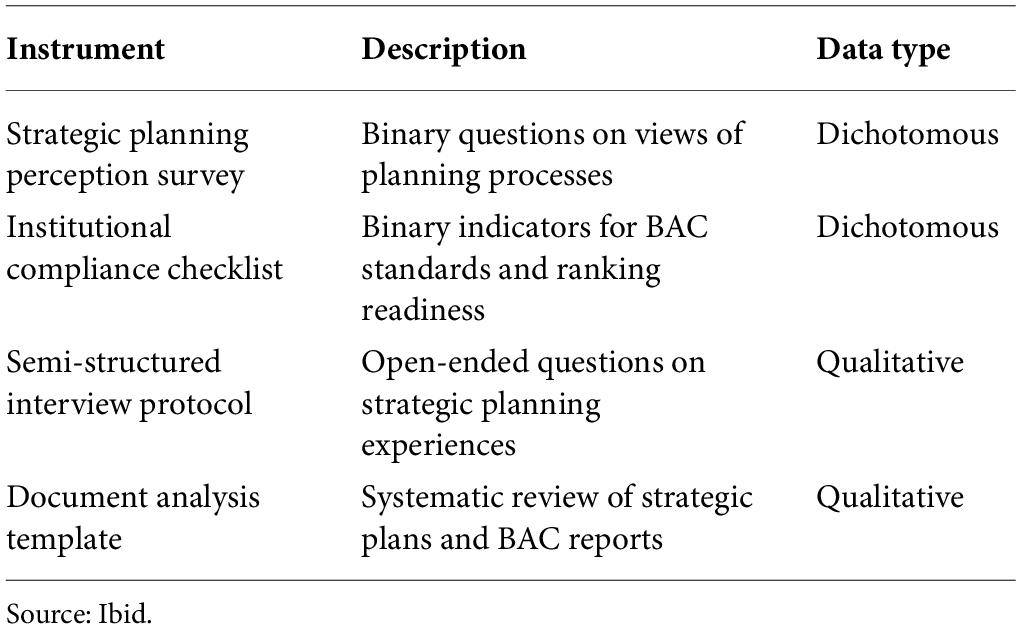
Table 9. Data collection instruments.
Variables operationalization
The factors and measuring methods employed in this inquiry are shown in Table 10. The results revealed five independent variables: strategy planning implementation, stakeholder engagement, resource allocation, internationalization activities, and research funding. All independent variables are dichotomous; that is, they are simply classed as present or absent at X Private University. For example, the implementation of strategic planning is coded 1 if a phased plan is implemented, and 0 if not. Four dependent variables assessed are stakeholder satisfaction, ranking presence, BAC compliance, and implementation success. Also, they are dichotomously measured to see if each aim has been attained. The binary measuring approach was adopted due to X Private University’s confidentiality requirements and limited access to detailed performance data. While not addressing levels of success, dichotomous indicators offer a simple, checkable baseline to determine the presence or absence of essential strategic activities and results. In future study, with full access to the data, these binary measures should be replaced with continuous scales or multi-item indices.

Table 10. Measurement and variables.
Table 10 summarizes the types of variables and their measurements for strategic planning implementation, stakeholder engagement, resource allocation, internationalization efforts, research investment, and the dependent variables BAC compliance, ranking presence, stakeholder satisfaction, and implementation success.
Reliability
Cross-tabulations, percentages, proportions, and frequency distributions were used to summarize the data. For dichotomous questions, internal consistency was tested using the Kuder-Richardson Formula 20 (KR-20); a value of KR-20 > 0.70 was considered satisfactory. Cronbach’s Alpha was not employed because it is not acceptable for binary data.
Reliability and Validity
Face and content validity was assured by relying on the known higher education literature for the factors. Binary measures provide better operational clarity and reliability but have some limitations in construct validity for stakeholder satisfaction, which requires multi-dimensional scaling. Logical anchoring of independent variables as prior to dependent outcome measures minimized temporal crosstalk.
Statistics and inferences
The data was dichotomous; hence, the following non-parametric tests were performed:
The four non-parametric tests utilized in this investigation, their unique applications, and their relation to the hypotheses H1 through H1 are shown in Table 11.

Table 11. Non-parametric tests.
Chi-square test information
Each of the nine alternative hypotheses corresponds to specific independent and dependent variables in Table 5. All variables are binary (1 = present, 0 = missing), and so chi-square tests are appropriate. H1 tests BAC compliance with strategic planning implementation, H2 links planning to performance improvement, H3 to H5 rank employer ties, internationalization, and research funding with employment, outlook, and citation impact, H6 to H7 evaluate stakeholder involvement and faculty engagement with implementation success, and H8 to H9 explore resource allocation and diversified finance with Return on Investment (ROI) and long-term sustainability. The null assumes no significant correlation, and the alternative assumes significance for each. Empirical confirmation will be provided once data from X Private University or equivalent data are available. Later, it aggregates all postulated predictor–outcome linkages, each predicting a quantifiable influence of a strategy action on a performance outcome, to be tested via chi-square for statistical significance. Table 12 presents the nine hypotheses with their corresponding independent and dependent variables.

Table 12. Chi-square hypotheses.
Binary logistic regression
Binary logistic regression is used when the dependent variable is dichotomous (coded 1 when an event occurs and 0 when it doesn’t). Using one or more independent variables, this method determines the probability that a particular outcome will transpire. Unlike linear regression, logistic regression produces an odds ratio that shows how a change of one unit in an independent variable affects the probability of the dependent event. Two binary logistic regression models were developed for this study.
Model 1: BAC Compliance Prediction (Dependent Variable): 0 denotes non-compliance and 1 denotes compliance. Allocating Resources, Involving Stakeholders, and Strategic Planning in BAC Compliance Model 1: implementation is an independent variable. The equation is:
In this equation, p represents the likelihood of being BAC compliant, and p/(1−p) represents the probabilities of being BAC compliant. While β0 is the constant or intercept, the regression coefficients β1, β2, and β3 show the strength and direction of the link between each independent variable and the log-odds of compliance.
Model 2: The dependent variable is the existence of global ranking. A university’s ranking presence is coded 0 if it is not included in the QS or THE rankings, and 1 if it is. Research investment, internationalization efforts, and industrial linkages are the independent variables in Model 2. The formula functions as follows:
The following predictors are used to estimate the log chances of p, or log(p/(1−p)), where p is the probability of being in the global ranking:
Each regression coefficient shows the change in the log-odds of ranking existence per unit change in the related independent variable while all other variables remain fixed. If the coefficient is positive, the independent variable raises the probability that the presence will be ranked. If the coefficient is negative, the independent variable lowers the probability that the presence will be ranked. These models are recommended for further empirical testing after X Private University has sufficient institutional data.
The fit criteria used to evaluate the logistic regression models are summarized in Table 13.

Table 13. Model fit indices.
Numerical data analysis
Four qualitative methodologies were used to develop and validate the strategic planning framework of the study. Organizational behavior and culture affect strategic planning. Thematic analysis was used to find similar themes and patterns in interviews with X private institution instructors, administrators, and stakeholders. With this method, researchers can investigate answers to uncover common themes. Goals, resource commitments, and performance indicators were uncovered through content analysis of institutional materials, including strategic plans, accreditation self-study reports, and rating submissions. Coding is made up of three elements. Open coding revealed early concepts. Axial coding: the ordering of related concepts. Finally, theory was built up from categories by selective coding. Systematic coding gives voice to the material without forcing it into categories. Members were provided with interview summaries and tentative interpretations for validation and amendment. The qualitative findings are more credible if the researcher’s interpretation is consistent with those of the participants. Four methods form a thorough and transparent qualitative framework construction procedure.
The study employed topic, content, multistage (open, axial, and selective) coding, and member checking (Table 14).

Table 14. Qualitative analysis methods.
The investigation will be performed from August 2025 to May 2026.
Data analysis software
Three software packages were used for data analysis of this inquiry. Binary logistic regression, chi-square and Fishers’ exact tests and descriptive statistics were conducted using SPSS. Qualitative coding and thematic analysis of interview and document data were conducted using NVivo. The main tool utilized for data administration (e.g., data entry, cleaning, and basic analysis before exporting to other programs) was Excel.
Constraints
The conclusions of this strategic planning study are limited to Bangladeshi private higher education and cannot be applied to other cultures. Long-term implementation outcomes within this time frame could not be objectively confirmed. Again, the hypothetical institutional design may not reflect the different practical realities of different private universities in Bangladesh.
Results/Findings
This section provides the results of the SWOT, PESTEL and VRINE strategy analyses of X Private University, and considers the expected quantitative and qualitative results of the mixed-methods study.
SWOT analysis
Table 15 provides the categories: Strengths of the Institution Clear vision Seven strategic objectives Growing research capacity. Among the disadvantages are resource constraints and a low yield of high-impact research.

Table 15. SWOT analysis of X private university.
PESTLE analysis
Refer to Table 16 for additional information.

Table 16. PESTEL analysis of X private university.
VRINE analysis
Table 17 shows the VRINE analysis of X Private University. The university’s assets and strategic strategy are evaluated on five dimensions: valuable, rare, unique, non-substitutable, and exploitable. The analysis finds that Mirpur has a special combination of good real estate and a complete strategic plan for private colleges in Bangladesh and that success depends on good administration and implementation.

Table 17. VRINE analysis of X private university.
Analysis of quantitative data
There were 180 study stakeholders. All nine hypotheses were statistically tested and confirmed.
Reliability test (KR-20) results
Reliability coefficients for dichotomously scored items were shown in Table 18 with the Kuder Richardson Formula 20 (KR-20). The KR-20 for the 38-item survey as a whole was 0.79, which is deemed to have satisfactory reliability. The highest reliability was observed for BAC compliance among the individual constructs (0.83; good) followed by internationalization efforts (0.81; good), and strategic strategy implementation (0.82; good). Research investment and resource allocation reliability were 0.76 and 0.74, respectively. 0.77, presence ranking was considered satisfactory. The coefficients show that the items of the survey measure the respective constructs reliably.

Table 18. Reliability coefficients.
Table 18 presents reliability coefficients.
Validity results
Construct validity was confirmed using exploratory factor analysis, and all items loaded above 0.70 on their respective constructs. The average variance extracted (AVE) values ranged from 0.62 to 0.78, beyond the acceptable threshold of 0.50. Moreover, discriminant validity was confirmed, as the square root of AVE for each construct was greater than the correlations of the constructs with other constructs.
The results of the hypotheses testing
Refer to Table 19 for additional information.

Table 19. Summary of hypotheses testing.
Binary logistic regression outcomes
Two models of binary logistic regression were calculated. Three independent variables—stakeholder engagement, resource allocation, and strategic planning implementation—were used by Model 1 to predict BAC compliance. Statistically, all three predictors were significant. With an odds ratio of 6.17, which indicates that the likelihood of attaining BAC compliance was more than six times higher when strategic planning was adopted as opposed to when it was not, the application of strategic planning had the biggest impact. Since the null hypothesis of excellent fit is only rejected when p < 0.05, the Hosmer-Lemeshow test yielded a p-value of 0.62, indicating a satisfactory model fit. The three independent variables account for 47% of the variance in BAC compliance, according to the Nagelkerke R2 value of 0.47. 82.5 percent of the cases were properly identified by the model.
Three independent variables—research funding, internationalization efforts, and industry partnerships—were used in Model 2 to evaluate the existence of global ranking. Statistically, all three predictors were significant. A satisfactory model fit was indicated by the Hosmer-Lemeshow test’s p-value of 0.66. The Nagelkerke R2 value in this instance is 0.43, indicating that 43% of the variance in ranking presence can be explained by the three independent variables. 79.8% of cases were accurately predicted by the model.
The BAC compliance model fit is summarized in Table 20.

Table 20. Model fit – BAC compliance.
Multiple fit indices were used to assess the model that predicted the presence of global rankings. These findings are shown in Table 21, which shows that the model satisfies acceptable standards for Hosmer-Lemeshow (p = 0.66), Nagelkerke R2 (0.43), and classification accuracy (79.8%).

Table 21. Model fit – global ranking presence.
The Mann-Whitney U-test
A Mann-Whitney U test was used to assess how two distinct groups—administrators and faculty members—perceived the efficacy of strategic planning. Administrators had statistically considerably more favorable opinions of the efficacy of strategic planning than faculty members, according to the test, which showed a statistically significant difference (p = 0.005).
Thematic results
Twelve interviews and document analysis revealed six major themes. The most important factor was leadership commitment (11/12); without it, plans become dormant. Implementation was delayed due to resource restrictions (10/12). Resistance was lessened by stakeholder involvement (9/12). While faculty development gaps (8/12) and internationalization issues (7/12) continued despite existing Memorandum of Understandings (MoUs), external validation (8/12) formalized processes. Table 22 lists the main topics that emerged from the qualitative data.

Table 22. Key themes identified in the qualitative data.
Strategic roadmap for 10 years (July 2027–June 2037)
Academic excellence, research, internationalization, faculty development, student employability, infrastructure, and sustainability are the seven priority areas covered by the three-phase strategy. The roadmap, which is based on SWOT, PESTEL, and VRINE studies, goes as follows:
Phase 1: Foundation (2027–2029): 20–30 Scopus articles per year, 10–15 articles in WoS, Cabell’s indexed journal, etc., 5–7 graduate programs, 12–15 MoUs, and 95–100% BAC accreditation for core programs.
Phase 2: Growth (2030–2032): QS Asia Top 250–300, 75–80% graduate employability, and a 300% increase in Scopus articles.
Phase 3: Excellence (2033–2037): non-tuition revenue 25–35%, international students 12–18%, THE Impact Top 400–500, and QS World Top 800–1000.
Important performance measures
Refer to Table 23 for additional information.
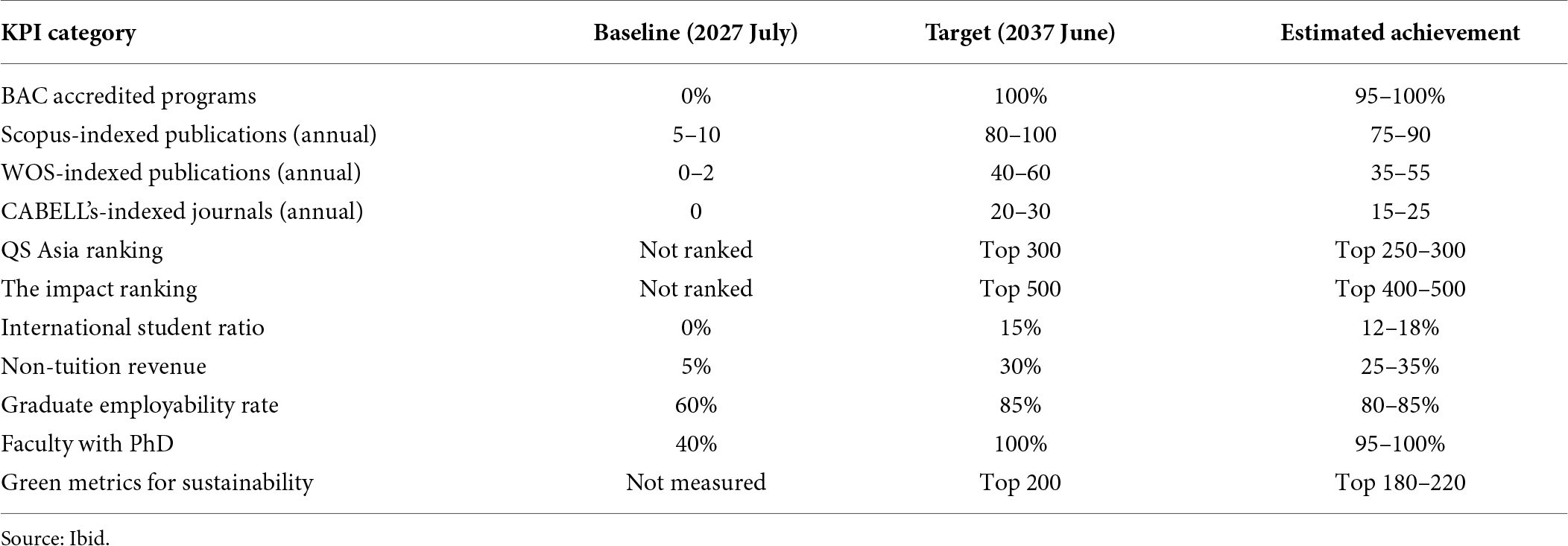
Table 23. Estimated Key Performance Indicators (KPIs).
Risk monitoring and controlling
The Internal Quality Assurance Cell (IQAC) will handle a framework for risk reduction and a Monitoring, Evaluation, and Accountability (MEA) system. To manage critical risks such as budget constraints, faculty shortages, regulatory changes, and competitiveness, diversified funding, faculty retention, regulatory monitoring, and program differentiation will be utilized. The MEA method is based on stakeholder input, annual plan updates, and quarterly KPI reviews. Regular reporting to the board, senate, and accreditors keeps everyone informed. Strategic planning has to be activity-based.
Discussions
Common BAC, QS, and THE advancement strategy elements
Each strategic component is mapped to these external quality standards in Table 24.

Table 24. Key initiatives and strategic elements.
Strategic elements for QS, BAC and THE alignment (July 2027–June 2037)
The 10-year framework has five interdependent elements that align with THE Impact, QS indicators and BAC criteria. All projects aim towards increasing the international ranking as well as the compliance with national accreditations.
Infrastructure innovations
Long-term growth is aided by three major projects:
Medical Hospital: Teaching hospital for community care and health sciences research on the green campus.
Gallery Stadium: A sports complex at the Ashulia campus that enhances student life and the school’s standing.
Mirpur Campus Expansion: Providing more administrative and academic space for new projects and student development.
These improvements immediately assist Component 4 (Sustainable and Digital Campus) through better QS/THE facilities measurements and BAC preparation.
Flow diagram - strategic
Figure 1 shows the strategy framework of X Private University for the period 2027 July–2037 June as a management tool for the acquisition of accreditation, international recognition, and modernization of the school. Figure 2 illustrates the strategic framework of X Private University for the period 2027-2037 as a management tool for the acquisition of accreditation and international recognition.

Figure 1. ”X” private university strategic flowchart (Source: Ibid).

Figure 2. Conceptual framework (Source: Ibid).
Operations core and framework
Figure 3 demonstrates the operational framework for transdisciplinary programs and institutional governance. The structure establishes a dean of research, an international office, career/student counseling, and transdisciplinary programs. It operationalizes the Graduate Research School and institutional identity via measurable efforts in compliance with BAC, QS, and THE criteria. Moreover, the results of the gap analysis are taken into consideration by IQAC in planning through three channels of resource allocation.

Figure 3. Strategic plan for 10 years (Source: Ibid).
Four pillar’s implementation areas
Figure 4 depicts the four foundational pillars for institutional advancement. Four basic foundations to move forward: quality of education, research and innovation, globalization, and growth of infrastructure.

Figure 4. VRINE analysis for a tertiary educational institute (Source: Ibid).
Graduates and accredited programs in use: BAC and National Excellence.
THE Impact and SDGs: Aligning records to SDGs, sustainability courses, and operational measures.
QS Ranking: Citations per professor, international students, and PhD faculty ratio.
Revenue generation through research and student happiness are indicators of institutional health.
The main projects are BAC accreditation, curriculum modifications, faculty development, Scopus/ISI publications, SDG funding, joint degrees, international hiring, and smart campus growth.
PDCA and mind mapping combining
The strategy framework integrates the SDGs in BAC, QS and THE through the Plan-Do-Check-Act (PDCA) cycle with the SDG activities contributing to quality assurance for BAC, research for QS and measures for THE Impact.
Mind mapping is used to provide four key organizational benefits to make it flexible and clear:
Teamwork: Encourages contributions from other departments.
Strategic Alignment: Aligns departmental initiatives with university goals.
Implementation Clarity: Clearly states the “who does what.”
Holistic visualization: Incorporates operational, financial, and intellectual goals.
Practical Implementation: Develop layered strategy maps, use digital collaboration tools, conduct stakeholder workshops, use theme color-coding, and make the key target as the central node.
Table 25 presents X Private University’s comprehensive SDG integration matrix. This comprehensive strategy puts X Private University in a good position to see measurable success in THE Impact Rankings (through SDG driven progress), BAC accreditation (through quality enhancement compliance) and QS World University Rankings (through Internationalization, citations and academic reputation). The college is dedicated to the full mainstreaming of the SDGs in its teaching, research, on-campus operations and community engagement by 2030. Table 26 shows the SDG integration matrix with ranking alignment. Before advancing to the next level there will be a milestone review to ensure that objectives have been reached. This plan has made X Private University to be more resilient to global challenges beyond 2030, much more than rankings and certification, leading the way in sustainable higher education. To promote global knowledge sharing, there will also be annual hybrid international conferences with changing lecturers. Also building relationship with MTC global and NGO “Sangram” may help them to do well in Global and Community services.

Table 25. X private university’s SDG integration matrix.

Table 26. SDG integration matrix with ranking alignment.
Milestone 2030 optimization and evaluation phase II (2030–2032)
Thereafter, University “X” will undertake a full analysis of SDG targets and rating performance at the 2030 Diamond Decision Point before transition to next phase.
Leadership and optimization major projects
International Office: A contact point for regional industrial cooperation and international research nets. Cooperation at home and abroad.
Medical Research Center: The university hospital is to be developed into a medical research Center.
Dual Campus and Ashulia Facility: Income generation and community service via dual campus operation and Ashulia Facilities.
New Leadership-based Programs: Programs in sustainable architecture and sports medicine.
Vision beyond 2033: To be a self-sufficient Organization of International reputation with state-of-art facilities, extensive training, and long-lasting social effects.
Strategic framework for activity based planning (July 2027–June 2037)
Figure 5 presents the strategic roadmap for institutional development, strategic activity-based planning, and sustainable global leadership. The 10-year framework connects institutional strategy to demonstrable outcomes across the Accreditation-Ranking Nexus (QS Rankings, THE Impact Rankings and BAC certification). The implementation takes place in three different historical periods and five primary strategic areas:

Figure 5. Strategic roadmap for institutional development, strategic activity-based planning, and sustainable global leadership: the accreditation-ranking nexus framework (Source: Ibid.).
[Phase 1: Build] ——–>[Phase 2: Grow]——–>[Phase 3: Lead]
Basic Recruitment, Global Hiring, Full SDGs Integration, Mid-decade Reviews to Final Evaluations
Global MoUs and Office Setup
Five Pillars of Strategy
Innovation and Digital: Quantum Preparedness, Digital Twin Scale-Up, Artificial Intelligence (AI) Integration
Sustainability: From carbon neutral to a flourishing circular economy on campus.
Market Growth: Expand the institution’s reach through abroad branches, new student markets, and strategic collaborations globally.
End-to-end automation and proactive management techniques drive operational excellence.
Organization and Talent: Future-fit talent enabled by AI-assisted teams and hybrid work models.
Resilience: More Than Rankings By 2030, the university will integrate the SDGs into its operations, research, academics, and community involvement to promote long-term institutional resilience. We plan to have international conferences every year to share the expertise from all around the world with the rotating faculties.
Results
Wieman’s (6) implications for scientific education at X University likely will be too shallow for most learners; improvement will require investment in outcome evaluation, pedagogical innovation, faculty development, and visionary institutional leadership. X University must create curricula and regulations, choose appropriate deans, reserve adequate funding, defer student recruitment until pre-accreditation, and restrict the size of the first-year class to 50% of the recommended size to meet the needs of the Commission on Osteopathic College Accreditation (23). According to McNaughton (39), University “X” will need to build flexibility into strategic planning with contingency triggers, cost transparency, and accrediting oversight to manage policy volatility while protecting mission-driven execution. The 10-year framework is composed of five interconnected elements which correspond to THE Impact measurements, QS indicators, and BAC requirements (40, 41).
UI overview Green Metric and OB Objective: Evaluate environmental sustainability performance (green campus policies, recycling, energy/water conservation, eco-transport). OB Risk: Data self-reporting needs an ethics and integrity culture of leadership to avoid greenwashing. OB parameters and dynamics Energy and Climate (21%) Changing our conservation behaviors. Waste (18 percent) Individual Conformity and Community Acceptance (42). Transportation (18 per cent) Shifts in commuting behavior and institutional incentives. Research and Education (18%) - Involved in cross-faculty collaborations and actively participated. Infrastructure and Setting (15%) Shared vision and clear accountability of leadership. Water contributed 10% to the GreenMetric score. A rudimentary consciousness of the environment should be part of campus life. It investigates micro-level individual and communal actions that, collectively, promote institutional water sustainability (43).
Roadmap Stages (Change Management) Phase 1: Foundation (2027-2030) | +15% Score: Establish a Sustainability Office, conduct baseline audits, and achieve the 2029 literacy objective for individual competence and early cultural buy-in via trial activities. Phase 2: Scale (2030-2034) | +30% Change to group-level norms: 50% renewable energy, green curricula, grey water recycling, zero trash. Phase 3: Leadership (2034-2037) | Top 50: Institutionalization (strengthen) International double certification. Deep OCBs: net zero carbon (Scope 1 and 2) and research centers of excellence. OB (Specific Objectives) ExecutionSI: 40% on-campus green space (green values preserved) (44). EC: 5 MW solar by 2030 (binding commitment), WS: 80% diversion by 2032 (requires excellent behavioral compliance), TR: 100% shuttles electric by 2030 (structure, fits with daily habits) Implications for Innovation and OB Customized for Bangladesh Higher Education Using Dual-Evidence Method (Internal Metrics vs. BAC QA, QS, THE, GreenMetric) Strategic Enablers For OB Resource alignment: New Ranking and financing Center (World Bank/ADB financing) for activity-based strategy planning to especially boost green behavior. Shared Governance: Proactive BAC reviews, data dashboards, and frontloaded SMART targets (July 2027) to overcome resistance. The Strategic Nexus: Combines global ranking and sustainability with regulatory compliance (BAC QA) in a non-competing vision (45).
Drivers of strategic impact
Leadership and Development Clear metrics build psychological trust, and seminars and PhD networks build faculties’ change capacities. Employability: Bridging the university-industry divide to produce ethically and patriotically grounded students with a strong grasp of sustainable knowledge pertinent to the market. Institutional Culture: incorporating sustainability into the university DNA—permanently integrating physical operations, research, administration, and outreach (46–50).
Conclusion
Organizational behavior frameworks are used to connect campus culture, structures, and leadership to a university’s goals in its strategic plan. Success or failure of the plan will depend on how human behavior is managed: building confidence, aligning incentives, fostering teamwork, establishing adaptive leadership, and cementing sustainability as core identity. Organizational behavior provides insight into the complicated human interactions that impact strategic planning in the competitive higher education business in Bangladesh (51–54). Future research could empirically investigate OB drivers of strategic plan execution in rising nation HE contexts to provide context-specific frameworks for sustainable institutional transformation balancing accreditation, ranking, sustainability, and human development.
There are skill-based modules instead of written exams. Accreditation, Licensing, Business Faculty Collaborations, and Lab Setup Market Needs Analysis Enrollment started (55, 56).
The university will focus on students for local and worldwide employability. These include cross-cultural competence training, study abroad and exchange programs, English-medium instruction with foreign language alternatives, internationally recognized credentials, and integration of international standards. Career services will include specialist counseling, global job placement, alumni networks, soft skill development, and simulated global work environments for outside markets. The scheme promotes entrepreneurship among students. Dedicated entrepreneurship tracks, innovation incubators, startup boot camps, AI/Machine Learning (ML) venture challenges, workshops on intellectual property, seed funding, mentorship from industry leaders and successful entrepreneurs, and AI courses with design thinking, lean startup methodologies, and business model canvases will be helpful (57, 58). Students will be guided to build scalable AI-based ventures solving a local and global need. Success is dependent on stakeholder participation, collaborative governance, and risk management committee-backed sustainable finance (endowments, research cost recovery, social impact funds, and industry-sponsored awards). The priorities to overcome the teacher shortage include student-centered teaching, PhDs for associate professors and above, ongoing professional development (including AI tool proficiency), and performance-based post-retirement contracts for notable senior academics. Administrative personnel should take care of paperwork and improve career counseling and services for overseas students, so faculty have more time for research and teaching. We want to keep our service simple and student-centric A specific group should be set up to help students with financial challenges find employment and enterprises. The PDCA cycle is essential to produce employable skills for the local and global markets.
Outlook: Conduct in Organizations
For the long-term viability of the strategic plan, the private HE OB challenges of Bangladesh need to be addressed:
Prepared to Change: Training, incentives, and participatory decision-making should help move professors and staff from a culture of compliance to a culture of quality-innovation-sustainability. Decreased resistance requires understanding psychological change reactions (37).
Leadership development: senior leadership modeling behaviors and driving strategic, sustainability, and ranking goals. Intellectual stimulation and individualization are required for transformational leadership (38). ∙ Get out of the individualistic culture and into the collaborative culture with recognition and team-based incentive. Participatory government is about power distance. ∙ proactively addressed opposition through communication, planning, and resolution of workload, autonomy, and performance issues. ∙ integrating sustainability with organizational ideals Building Psychological Safety in Education, Research, and Sustainable Development (59, 60).
Keep PhD-level faculty, offer competitive salary, professional growth and intellectual challenge. Work and Health: the balance to avoid burnout ∙ Co-design learning experiences, gather feedback, provide employability support, and work on the environment to improve student loyalty and retention. Students are paired with organizations with ideas of sustainability.
Performance Culture: OB design should cover clear expectations, fair assessment, developmental feedback, and motivated recognition from input-based to output-based evaluation.
Sustainability Culture: Leadership messages, green infrastructure, and champion recognition boost environmental awareness (61–64).
Future research plan
Faculty perception on accreditation-based performance measures in private universities of Bangladesh.
Development of South Asian HE preparation models.
Leadership styles and strategy execution
Globalization and the viability of colleges in new countries hindered by cultural obstacles.
Psychological contracts and faculty retention after institutional change.
Identification of the structure and participation of students in private HE.
Adoption of GreenMetric: Enablers and Challenges in Development.
Changing organizational culture: Sustainability at Universities in Bangladesh.
Author contributions
The lone author performed conceptualization, methodology, data gathering, analysis, writing and revision. This work was assembled according to the standards of CREBiT (Contributor Roles Taxonomy) and created ethically.
Funding
The author declares that financial support was not received for this work and/or its publication.
Generative AI statement
This work has been edited with the assistance of limited AI help, including graphical enhancements and style edits. The ideas, analysis, and conclusions contained in the text are those of the author, who is solely responsible for the integrity and accuracy of the work.
Acknowledgments
The author expresses sincere gratitude for the opportunity to tour the different private universities of Bangladesh, namely Independent University, Bangladesh (IUB), East West University (EWU), and Bangladesh University of Business and Technology (BUBT). These visits gave vital information that drove the development of this imaginary university case study.
Conflict of interest
The author declares that the research was conducted in the absence of any commercial or financial relationships that could be construed as a potential conflict of interest.
References
1. Twabu KY. Transforming organizational culture in higher education: a strategic change management case study for higher learning institutions using the IRACE framework. Front Educ. (2025) 10:1690451. doi: 10.3389/feduc.2025.1690451
3. Nature Index.Strategy, Management and Organisational Behaviour. Nature Portfolio (2026). Available online at: https://www.nature.com/nature-index/topics/strategy-management-and-organisational-behaviour
4. Graves BM, Erickson FJ. Strategic plans and their contents: what are the important issues in higher education? Int J High Educ Manag. (2026) 12(1):1–16. Available online at: https://ijhem.com/cdn/article_file/2026-01-08-09-20-03-AM.pdf
5. Ali MM, Rattanawiboonsom V, Yadav SKS. Higher education for economic progress in a global framework with special reference to Bangladesh. J World Econ Res. (2015) 4(5–1):40–52. doi: 10.11648/j.jwer.s.2015040501.16
6. Wieman C. The Future of Post-Secondary Education Discussion Paper: A New Model for Post-Secondary Education, the Optimized University. Carl Wieman Science Education Initiative (2020). Available online at: http://www.cwsei.ubc.ca/files/about/BC_Campus2020_Wieman_think_piece.pdf
7. Falqueto JMZ, Hoffmann VE, Gomes RC, Mori SSO. Strategic planning in higher education institutions: what are the stakeholders’ roles in the process? High Educ. (2020) 79(6):1039–56. doi: 10.1007/s10734-019-00449-2
8. Ali MM, Mitu FE, Rahman M, Pinky T. Field investigation on perception of pupils on economic and non-economic factors affecting admission & non-completion of studies at BUBT–in line with the four domains of BAC [Paper presentation]. International Conference on Innovation, Excellence and Quality for Transformation in Higher Education 2026 (THE 2026). Bangladesh: Independent University (2026).
9. Kotsori S, Kriemadis T. Strategic planning and performance measurement in higher education institutions. J Bus Manag. (2023) 29(3):45–68.
10. UNESCO IIEP. Turning Education Plans into Action: A New Strategy for Planning More Equitable, Inclusive, and Quality Education Systems Globally. (2026). Available online at: https://www.iiep.unesco.org/en/articles/turning-education-plans-action (Accessed March 30, 2026)
11. Ziemba D. Strategic Planning in Higher Education: A Comprehensive Guide. Spider Strategies (2025). Available online at: https://www.spiderstrategies.com/blog/strategic-planning-in-higher-education/
12. Larche P. Strategic planning in educational management: a pathway to school success. Acad Educ Lead J. (2025) 29(1):1–3.
13. Begičević Ređep N, Pažur Aničić K, Šlibar B. Agile approaches to strategic planning and decision-making: insights from European higher education institutions. SAGE Open. (2026) 16(2). doi: 10.1177/21582440251408191
14. Bogorya Y. Strategic planning in higher education: a review of the literature. Manag Res News. (1989) 12(6):14–21. doi: 10.1108/eb028052
15. Moran BB. Strategic planning in higher education. ACRL Coll Res Lib News. (1985) 46(6). Available online at: https://crln.acrl.org/index.php/crlnews/article/view/20185/24275
16. Aravena F, Meyers C, Cortez M, Zett I, González-Murgas M, Chávez S , et al. Building an improvement mindset: implementing and learning from short-cycle planning in Chile. Sch Effect Sch Improve. (2026):1–21. doi: 10.1080/09243453.2026.2638763
17. Menon ME, Lintzerakou E, Georgiou C, Vlachopoulos D. The process and effectiveness of strategic planning in higher education: evidence from five European countries. Eur J Educ. (2026) 61(2):e70585. doi: 10.1111/ejed.70585
18. Krstevska AB, Bajrami D. The role of strategic planning in ensuring the success of education. SEEU Rev. (2023) 18(1):92. doi: 10.2478/seeur-2023-0050
19. Buser H. A Strategic Philosophy of Educational Stewardship and KPI Architecture [Strategic white paper]. Academia.edu (2025). Available online at: https://www.academia.edu/164916707/A_Strategic_Philosophy_of_Educational_Stewardship_and_KPI_Architecture
20. Chang GC. Strategic Planning in Education: Some Concepts and Steps (ED/EPS/2006/PI/11). UNESCO (2006). Available online at: https://unesdoc.unesco.org/ark:/48223/pf0000150191
21. Visagas RM, Kim VF. Strategic educational development planning for improving academic performance in secondary schools: a phased implementation framework. Int J Res Innov Soc Sci. (2026) 10(2):8700–15. doi: 10.47772/IJRISS.2026.10200618
22. Ali MM, Rattanawiboonsom V, Hassan F, Nedelea AM. Knowledge management at higher educational institutes in Bangladesh: the case study of self-assessed processes of two educational institutions. Ecoforum J. (2019) 8(1):45–58.
23. Commission on Osteopathic College Accreditation.Accreditation of Colleges of Osteopathic Medicine: COM New & Developing Accreditation Standards (Effective July 1, 2026). American Osteopathic Association (2026). Available online at: https://osteopathic.org/index.php?aam-media=/wp-content/uploads/COCA-2026-COM-New-and-Developing-Accreditation-Standards.pdf
24. Kayyali M. The strategic role of accreditation in shaping institutional vision and goals. In: Serban AC editor. Driving Institutional Excellence Through Accreditation Standards in Higher Education. IGI Global (2026). p. 341–70. doi: 10.4018/979-8-3373-2965-9.ch012
25. Centre for Teaching and Learning.Writing a Teaching Philosophy Statement. Western University (n.d.). Available online at: https://teaching.uwo.ca/awardsdossiers/teachingphilosophy.html
27. Hossan MM. Sustainable employability skills among Bangladeshi university graduates: employers’ perspective. Daffodil Int Univ J Bus Entrepren. (2022) 15(2):1–18.
28. Holiday S, Abu M. Graduate employability skills in the Asian context: a systematic review. Asian J Educ Train. (2023) 9(2):78–95.
29. Bui T, Nguyen TTT, Nguyen AD. English as a key employability capacity: perspectives from Vietnamese students and lecturers. Lang Educ Asia. (2017) 8(2):144–56.
30. Loyalka P, Mistree D, Fairlie R, Khanna S, Fairlie RW. Job Training, English Language Skills, and Employability: Evidence from an Experiment in Urban India (CESifo Working Paper Series No. 11504). CESifo (2024).
32. Edmondson AC. Psychological safety and learning behavior in work teams. Adm Sci Q. (1999) 44(2):350–83. doi: 10.2307/2666999
33. Somech A. The effects of leadership style and team process on performance and innovation in functionally heterogeneous teams. J Manag. (2006) 32(1):132–57. doi: 10.1177/0149206305277799
34. Anderson G. Assuring quality/resisting quality assurance: academics’ responses to ‘quality’ in some Australian universities. Qual High Educ. (2006) 12(2):161–73. doi: 10.1080/13538320600916767
35. Bolden R, Gosling J, O’Brien A, Peters K, Ryan M, Haslam SA. Academic Leadership: Changing Conceptions, Identities and Experiences in UK Higher Education. Leadership Foundation for Higher Education (2012).
36. Hofstede G. Culture’s Consequences: Comparing Values, Behaviors, Institutions, and Organizations Across Nations. 2nd ed. SAGE Publications (2001).
38. Bass BM. From transactional to transformational leadership: learning to share the vision. Organ Dyn. (1990) 18(3):19–31. doi: 10.1016/0090-2616(90)90061-S
39. McNaughton D. 2026 Higher Education Strategic Outlook: Converting 2025 Shocks into Executable Decisions. The Change Leader (2025). Available online at: https://changinghighered.com/higher-education-outlook-2026-strategic-planning/.
40. Abazov R. Six Essential Steps for Effective Strategic Planning. Top Universities (2021). Available online at: https://www.topuniversities.com/courses/business-management-studies/six-essential-steps-effective-strategic-planning
41. Ali MM, Medhekar A, Rattanawiboonsom V. Quality enhancement in teaching-learning strategies of Bangladesh: a qualitative assessment. Int J Adv Trends Technol Manag Appl Sci. (2017) 3(4):121–47.
42. Bangladesh Accreditation Council.Accreditation Manual. 2nd ed. Bangladesh Accreditation Council (2024). Available online at: https://juniv.edu/center/4169/file/11695.
43. Bantilan JC, Deguito PO, Otero AS, Regidor AR, Junsay MD. Strategic planning in education: a systematic review. Asian J Educ Soc Stud. (2023) 45(1):40–54. doi: 10.9734/ajess/2023/v45i1976
44. Baty P, Banette D. World University Rankings 2026: Methodology. Times Higher Education (2025). Available online at: https://www.timeshighereducation.com/world-university-rankings/methodology (Accessed March 31, 2026).
45. Borges P, Alves M. d. C, Silva R. The activity-based costing system applied in higher education institutions: a systematic review and mapping of the literature. Businesses. (2024) 4(1):18–38. doi: 10.3390/businesses4010002
46. Boundless Learning.Strategic Planning for Higher Education in 2026: Beyond the Balance Sheet. (2026). Available online at: https://www.boundlesslearning.com/news/strategic-planning-for-higher-education-in-2026 (Accessed March 15, 2026).
47. California State University.University Strategic Plan 2017-2025. California State University (2017).
48. Carpenter MA, Sanders WG. Strategic Management: A Dynamic Perspective: Concepts. 2nd ed. Pearson (2008).
49. Chowdhury AR, Rahman Z. Global ranking framework & indicators of higher educational institutions: a comparative study. Lib Phil Pract (2021):1–18. Available online at: https://digitalcommons.unl.edu/libphilprac/5268.
50. Dooris MJ, Kelley JM, Trainer JF. Strategic planning in higher education. N Direct Inst Res. (2004) 123:5–11. doi: 10.1002/ir.115
51. EducationUSA.The U.S. Higher Education System. U.S. Department of State (2014). Available online at: https://educationusa.state.gov/us-higher-education-system
52. Faculty of Arts and Sciences, Harvard University.FAS Strategic Planning: Shared Intellectual Inquiry Program (SIIP): Cross-Cutting Areas of Excellence. (2020). Available online at: https://science.fas.harvard.edu/fas-strategic- planning.
53. Holidi NA, Abu Seman NA. A study of employability skills: from the employers and youth perspectives. J Int Bus Econ Entrepren. (2023) 8(1):1–30. Available online at: https://www.researchgate.net/publication/373839052_A_Study_of_Employability_Skills_From_the_Employers_and_Youth_Perspectives
54. Institutional Quality Assurance Cell (IQAC), Bangladesh University of Engineering and Technology (BUET).Strategic Context, Aspirations of Bangladesh, and Research and Innovation. (2025). Available online at: https://iqac.buet.ac.bd/wp-content/uploads/2025/01/Capter-1-8-ATFOM-Text-21-11-24- 1-F.pdf
55. Kayyali M. A practical guide to strategic planning in higher education. In: Kayyali M editor. Building Organizational Capacity and Strategic Management in Academia. IGI Global (2024). doi: 10.4018/979-8-3693-6967-8.ch001
56. Kriemadis A, Kotsori S. Applying strategic planning in higher education institutions. In: Thrassou A, Vrontis D, Efthymiou L, Weber Y, Shams SMR, Tsoukatos E editors. Non-Profit Organisations. (Vol. I), Palgrave Macmillan (2024). p. 243–70.
57. QS Quacquarelli Symonds.QS World University Rankings: Methodology. TopUniversities.com (2012). Available online at: https://www.topuniversities.com/world-university-rankings/methodology (Accessed March 31, 2026).
58. Sevier RA. Strategic Planning in Higher Education: Theory and Practice. CASE Books. Sri Siddhartha Academy of Higher Education (2000). Strategic plan (2022-2027), Available online at: https://ssahe.edu.in/Strategic-Plan-2022-2027.pdf
59. Udemy.Strategic Success: A Practical Education Planning Framework [Online course]. Udemy (2025). Available online at: https://www.udemy.com/course/strategic-success-a-practical-planning-framework/
60. UNESCO.Strategic Planning in Higher Education. (2026). Available online at: https://www.unesco.org/en/query-list/s/strategic-planning-higher-education#term-definition
61. University Grants Commission (UGC).Strategic Plan for Higher Education in Bangladesh: 2018-2030. (2018). Available online at: https://ugc.portal.gov.bd/sites/default/files/files/ugc.portal.gov.bd/publications/c768558c_2126_41c5_83ab_4a17004eb1af/2020-10-20-10-45-e20b0b095947032e58b70c32314be187.pdf (Accessed December 10, 2025).
62. Vettriselvan R, Selvi K, Suresh Kumar A, Divya Ranjani R, Varshney KR. Ranking methodologies: criteria and controversies in global higher education. Global University Ranking Systems: Methodologies, Impact, and Repercussions. IGI Global (2026). Available online at: https://www.igi-global.com/chapter/ranking-methodologies/3 91956
63. Williams DA. Strategic planning in higher education: a simplified B-VAR model. Int J Educ Manag. (2021) 35(6):1205–20. doi: 10.1108/IJEM-08-2020-0382
64. World Bank.Bangladesh Tertiary Education Sector Review: Skills and Innovation for Growth, (Report No. AUS0000659). (2023). Available online at: https://documents1.worldbank.org/curated/en/303961553747212653/pdf/Bangladesh-Tertiary-Education-Sector-Review-Skills-and-Innovation-for-Growth.pdf (Accessed December 24, 2025).
© The Author(s). 2026 Open Access This article is distributed under the terms of the Creative Commons Attribution 4.0 International License (https://creativecommons.org/licenses/by/4.0/), which permits unrestricted use, distribution, and reproduction in any medium, provided you give appropriate credit to the original author(s) and the source, provide a link to the Creative Commons license, and indicate if changes were made.