Introduction
One of the 17 Sustainable Development Goals (SDGs) focuses on challenges related to leadership and gender. The SDGs acknowledge that gender equality is not just a fundamental human right but also a prerequisite for a future that is peaceful, wealthy, and sustainable, according to the News Agency of Nigeria (NAN) (1). Gender equality and women’s economic empowerment are central to SDGs for 2030 set forward by the UN. The target of Sustainable Development Goal 5:5 is a new window of opportunity to address structural barriers that have held women back, causing them to lag behind men in most measures of economic opportunity and preventing them from significantly contributing to socio-economic and political development across the globe. Women are underrepresented in decision-making processes for a variety of reasons, including traditional gender norms, a lack of assistance for women and men to balance caring obligations with work, and business and political cultures (2). One of the top priorities the European Union (UN) has established for attaining gender equality is the promotion of equality between men and women in this area.
Gender disparity in academic leadership roles has been undergoing scrutiny and transformation, with increasing numbers of women entering the field and concerted efforts to recruit and retain them in higher education and the workforce (3). These efforts vary by country, influenced by policies, governmental strategies, and institutional initiatives within specific contexts. Despite progress, a global imbalance in gender parity persists. Regions like North America and Northern Europe are making strides in closing societal gender gaps but still face challenges in women’s representation in public institutions. Conversely, regions such as Southeast Asia and the Middle East, while rapidly recruiting women in public institutions, show the least improvement in closing overall gender gaps. Research indicates that women in leadership positions across various industries perform as well as, and sometimes better than, their male counterparts (4). Despite this, female leaders continue to face obstacles in attaining leadership roles.
Within universities, particularly in countries like Bangladesh and Malaysia, leadership roles are predominantly occupied by men. Bothwell (5) reported that only 18% of the female working population held leadership roles in the top 200 universities in 2016–2017. As of 2020, only three women serve as vice-chancellors (VCs) across twenty public universities in Malaysia. In Bangladesh, there is only one female VC and one pro-VC among 46 public universities. This gender disparity is evident globally, with low percentages of female VCs in Japan (2.3%), Kuwait (3%), India (3%), Turkey (7%), Malaysia (15%), and the UK (29%), while Hong Kong lacks any female VCs (6).
Similar gender disparities exist in other university leadership positions such as deputy VC, registrar, dean, and deputy dean, with fewer women holding these roles compared to men. This shortage of female representation is also prevalent in many other Asian countries, including India, Afghanistan, Nepal, Sri Lanka, Pakistan, and Bangladesh (7, 8). This calls for further research to address this issue. Despite their academic achievements, women encounter barriers to success in various professional fields, including academia. These barriers are rooted in existing inequalities within patriarchal family structures and institutional cultures that marginalize women (9). Calderon (10) highlights that in Sub-Saharan Africa, only 24.3% of university academics are women, hindering their advancement to leadership positions.
The glaring underrepresentation of women in top positions of academic institutions across most African universities cannot be underestimated (11). Nigeria continues to be a topic of discussion for international decision-makers and participants in the SDGs Gender Equality project. Being one of the many nations where tradition, custom, sexual stereotypes of social roles, and cultural bias operate against the exercise of rights and the full involvement of women on an equal footing with men in leadership positions, especially those in education. Nigeria is listed among the countries whose fortunes are most likely to improve as a result of gender equality. Nigeria is ranked 139th out of 156 countries in the World Economic Forum’s (WEFs) Gender Gap Index, and civil society organizations are concerned that the number of women in leadership positions in the country may be dwindling (12).
However, only 3.4% of women in Nigeria’s parliament and 8% of women hold ministerial positions. Nigeria is ranked higher than 10 other African nations in the 2019 WEF ranking, according to Nuhu, including Burkina Faso (129), Algeria (132), Egypt (134), Gambia (136), Mali (139), Togo (140), Mauritania (141), Côte d’Ivoire (142), Morocco (143), Chad (147), and the Democratic Republic of the Congo (149). But Rwanda (9), South Africa (17), Burundi (32), Zambia (45), Zimbabwe (47), and Ghana (107) outperformed Nigeria in that regard (13). Iceland, Norway, Finland, Sweden, Nicaragua, New Zealand, Ireland, Spain, Rwanda, and Germany are the top 10 nations in the world for gender equality (13). Women outnumber males almost everywhere in the field of education, but sadly, they are underrepresented in positions of leadership in the education sector. Academic staff are expected to contribute to their disciplines’ advancement through academic publications, innovation, securing research funding, effective instruction, service, leadership, and professional growth. This academic journey requires support and mentorship, typically provided by seasoned academics. However, female academics often lack critical research, leadership, and grant-writing competencies due to inadequate institutional support, limited networking, and insufficient mentorship, particularly from male counterparts. These barriers, often driven by patriarchal cultures and heavy teaching loads, restrict women’s career advancement, leading to lower representation in senior, decision-making roles.
There is a deluge of female educators but few female leaders. The established gap between men and women’s opportunities in society and in higher education is thus problematic in this study.
While earlier studies mostly focused on understanding gender issues in Nigeria, very little research exists on exploring the dynamics of gender and leadership gaps in universities in Nigeria with an eye towards its implication for SDGs 5:5. The general objective of the study was to explore the dynamics of gender and leadership in universities in Nigeria. Nigeria has started the pursuit of the fifth SDGs 5:5 – ensure women’s full and effective participation and equal opportunities for leadership in decision-making in political, economic, and public life. But it throws up a couple of questions: How did gender exacerbate the disparity in power between men and women in leadership roles in Nigerian universities? How can programs for gender sensitization in university settings change the prevalent mindset concerning gender bias in Nigerian universities? The study shall make a modest attempt to provide answers to the above questions with a view to developing insights on how to prevent compromising the chances of promoting equal distribution of resources, opportunities, and leadership positions in universities in Nigeria by 2030.
Literature review
The concept of gender
The role of gender in the social and symbolic environment is something that society is becoming more and more conscious of. According to Chigbo and Tartsea-Anshase (14), the symbolic world relates to how the real world is depicted and formed on television and in various factual and fictional genres. This is progressively influencing how society views the roles of men and women. The idea of gender needs to be clearly grasped as a unitary sociocultural variable. It is an all-encompassing factor in the sense that gender may be used to explain every other factor that cuts over multiple categories, including race, class, age, ethnicity, etc. Men and women differ in a variety of ways based on their gender, ranging from biological to societal. It refers to the attitudes and expectations that are socially built and acquired in relation to males and females. The main factor used to distribute tasks and duties is gender.
Institutions, ideas, interactions, and identities are influenced by gender (15). The World Health Organization (WHO) (16) defines gender as the socially constructed traits of men, women, girls, and boys. This covers interpersonal connections as well as the standards, behaviors, and roles that come with being a woman, man, girl, or boy. Social conventions, viewpoints, and behaviors associated with particular sexes are referred to as gender. What a person thinks, feels, and does also affects their gender. However, the associated prejudices are what have been successful in introducing and sparking debates in our culture. The existence of some discrimination and inequality as a result of this social construct has been made public by studies in various fields. Examining gender concerns in politics, reproductive health, and education, among other areas, helps to make this scenario clearer.
Leadership
Numerous investigations have been conducted in this field of leadership, but there is still no universal consensus on what leadership is and how it should be studied. Within educational institutions at all levels, all types of companies, as well as inside households, the individuals need to put into operation leadership skills. A leader is someone who has enough sway to change people’s opinions permanently and to make the changes more tolerable. It is mostly linked to influencing people’s mindsets toward carrying out their employment responsibilities. The fundamentals of leadership, however, apply to all leaders in all roles. For example, leaders must “have a sense of direction, they are the servants of their followers, share power with others, foster inclusiveness, value and support their people, led by example, and have the ability and willingness to learn continuously coupled with a capacity for honest self-assessment,” according to Mescon and Khedouri (17, p. 464), who define leadership as the “ability to exert influence on individuals and groups, directing their efforts toward achieving the organization’s goals.”
An alternative definition of leadership is “a dynamic relationship based on the individual traits of the leader and followers as well as the environment.” To put it another way, leadership involves setting a course and persuading people to follow it (18). The followers are the masters’ servants. In order to achieve academic excellence in the dissemination and acquisition of universal knowledge, values, and functional, technical, and scientific skills and competencies necessary for global growth and development, leadership within the university system plays a crucial role. The university is the pinnacle of an educational system where top talent is developed for the nation’s socioeconomic and political development.
Tertiary education ensures the training of educators, government employees, engineers, humanists, business owners, scientists, and a plethora of other individuals for every market economy (19). Therefore, effective university leadership should take into account fair female representation in leadership roles and be idiographic in human behavior and nomothetic in task performance in order to achieve sustained educational advantages.
Sustainable development goals
As the Millennium Development Goals (MDGs) came to an end in September 2015, world leaders gathered at the United Nations General Assembly (UNGA) 70th session in New York to establish a new global partnership for development known as SDGs. By the year 2030, 169 targets and 17 goals are to be accomplished. According to the SDGs Indicators Baseline Report from 2016, Nigeria is expected to focus on institutional and policy improvements to support the program and initiatives in order to pursue the possibility of attaining the SDGs in a way that is inclusive and people-centered.
The UN Secretary-General (20) describes the new agenda as a comprehensive, integrated, and transformative vision for a better society. It is a global agenda, our shared home, a people’s agenda, a plan to eradicate poverty in all of its manifestations, and a plan for cooperation, peace, and prosperity. It is based on gender equality and respect for everyone’s rights. Above all else, it pledges to leave no one behind. These core elements comprise the set of 230 indicators, 169 targets, and 17 goals. The suggested 17 objectives are listed below.
The 17 SDGs are a summary version of the 179 specific goals that must be met in order to improve people’s quality of life on Earth.
In order to successfully pursue and achieve SDG 5:5, which aims to “Ensure women’s full and effective participation and equal opportunities for leadership at all levels of decision-making in political, economic, and public life,” there must be a collective political will to develop, align, and promote pertinent policies regardless of political allegiances, religious beliefs, or sectional beliefs. To support and strive for the Nigerian people’s interests, there is a need for imaginative leadership. Olugbemi (22) asserts that a visionary leadership team will design or coordinate policies, foster an enabling environment, and oversee the administration of all national institutions in the interest of the vast majority of the population. Visionary leadership will live above religion, ethnicity, and sectional bias and uphold the tenets of the Nigerian constitution.
Theoretical foundation
The study adopts the radical feminist theory propounded by a 16th-century radical feminist, Jane Anger, in 1589 (23). Other modern radical feminists instrumental to the radical views are Alice Echols (24), Andrea Dworkin (25), etc. Feminism implies a radical ideology in favor of the liberation of women from traditional role-playing. Feminists recognize that there is a structural power imbalance in society based on differences in gender and sex. The goal of feminism is to achieve gender equality in social, economic, and political spheres. By opposing and destroying oppressive patriarchal structures, radical feminism seeks to establish just and equal societies. According to the radical feminist perspective, men and women think and rationalize in different but equally effective ways (26). They stress that women are more likely than men to accept some leadership philosophies than others (27). For change to be made, it is necessary to expose the skewed informal social norms that discriminate against women and are ingrained in institutional systems.
Radical feminist theory is relevant to the study because it offers a framework and a foundation for understanding gender inequality and the structural ways in which women are discriminated against, underrepresented in leadership roles, and subordinated due to their sex. The idea offers a rationale for why women in leadership roles are viewed as less capable leaders and pressured into silence or acquiescence. Feminist theories look at women’s roles, experiences, and interests as well as how sexism still discriminates against them. This type of feminism is referred to as “radical” because radical feminists seek to confront and overthrow these unjust structures in order to transform society. Consequently, radical feminists support gender equality. In order to create equitable and just societies, radical feminists work to reorganize social systems to ensure that male supremacy is eliminated. In order to investigate the dynamics of the gender and leadership gap in Nigerian universities in order to further the SDGs 5:5, the radical feminist theory is found to be credible on the basis of this explanation.
Methodology
The research employed a descriptive and qualitative methodology. Participant observation and reliable secondary sources provided the study’s data. The study was conducted between 2023 and 2025. These documentary sources include government publications, bulletins, newspapers, online resources, indexed journals, and textbooks. These documentary materials are complemented with the observation of leadership positions within the university community. To identify relevant scholarly contributions, the study utilized platforms such as Google Scholar, CORE, Science.gov, Semantic Scholar, and RefSeek. The Web of Science database was particularly employed for its breadth and reputation in curating academic literature. Retrieved sources were carefully searched, skimmed, and screened based on their relevance to gender and leadership gaps in universities in Nigeria. The study adopts secondary data for methodological coherence, using a search strategy that combined key terms such as “gender,” “leadership,” and “sustainable development”, in the context of the study.
Findings and discussion
How did gender exacerbate the disparity in power between men and women in leadership roles in Nigerian universities?
Women still face prejudice and injustice, despite the fact that the Nigerian Constitution guarantees gender equality and nondiscrimination. This frequently happens as a result of discriminatory laws, cultural and religious traditions, gender stereotypes, inadequate educational attainment, and the disproportionate impact of poverty on women. Iniobong (28) claims that the 10th National Assembly of Nigeria was sworn in to perform legislative duties earlier in June. Since the election of their top officials, the House of Representatives and the Senate have settled into their legislative tasks. It’s interesting to note, nevertheless, that the 10th Assembly saw a steady decline in the proportion of women elected to the national legislature.
The situation is appalling, especially in light of the growing calls for a gender-balanced parliament. Three of the 109 senators in the National Assembly are female, according to the data that is currently available, down from seven in the 9th Assembly (28). The 9th Assembly’s female senators all failed to win reelection despite having extensive parliamentary experience. Out of the 360 members of the House of Representatives, sixteen women were sworn in, a minor increase from the 13 in the previous House. The image shows a disproportionate number of men among the House members. In democracy, women are still disproportionately underrepresented and clearly marginalized in the legislative and executive branches of government. This trend flows from the national level to state and down to local levels where few women take the lead in local government as chairmen and councilors.
In addition, men predominate in leadership roles in colleges, and gender differences are plain to see. There is little consensus over how women actually lead, and it is challenging for women to enter the traditionally male-dominated world of leadership at universities. Even while some universities have created gender centers to increase the representation of women in leadership positions, it has all been in vain. University of Nigeria, Nsukka; Gender and Development Policy Center (Gen-Cent), Center for Gender Studies, University of Benin; Center for Gender Studies, Benue State University, Makurdi; Center for Gender Studies, Bayero University, Kano; and Center for Gender and Development Studies, University of Port Harcourt, are a few universities with gender centers.
For instance, barely 20% of women in academia work as vice chancellors or chief executives in the United Kingdom (29). In Sub-Saharan Africa, higher education institutions only employ 1% women as administrators. In India, there are 23% female department heads and 20% female deans. Women hold 18% of the dean positions in universities in Anglophone Sub-Saharan Africa (30, 31). The gender gap is extremely obvious in Nigeria. For instance, as of 2016, there were only 6 female heads of departments out of 77, and all 12 deans were male.
Men held the roles of vice chancellor, bursar, director of institutes, and deputy vice chancellor. There were only 11 female department heads and 1 female dean among the 85 department heads at Obafemi Awolowo University in 2015. Similar to 2015, there were 3 female deans out of 14 in 2016, suggesting a modest rise; however, there were only 9 female heads of departments out of 90, showing a fall. Additionally, just one of the nine departments that make up the Faculty of the Social Sciences at the University of Nigeria, Nsukka, had a female Head of Department during the 2022–2023 academic years. The remaining eight were male academics. However, the University of Nigeria, Nsukka is currently blessed to have two of her principal Officers, the Bursar and the Registrar all female. They depict the realities of gender imbalance in leadership positions in all the Nigerian universities (32). However, the leadership situation in these Nigerian universities is not different from that of other universities in Nigeria.
The academic environment of the university is typically masculinized, with a strong boys’ network in operation, and women constantly struggle to find the time to work toward network enhancements as well as the time to nurture professional friendships that help advance them on the job; as a result, women are unable to permeate the male domain. As a result, they are unable to climb the leadership ladder.
Furthermore, women are significantly underrepresented in Nigeria’s academic system. Despite being mainly male-dominated, teaching in Nigeria has a considerable number of female practitioners. But in most instances, this scarcely applies to the position of postsecondary institution president. Why? Despite the fact that the National Gender Policy (NGP) was created to support a 35% affirmative action (AA) for women—a policy that mandates women participate in all governance processes in Nigeria at a 35% rate—this is the case even though the policy was implemented in 2006. Although the NGP is acknowledged, it is not used since the necessary structures and procedures are not in place.
For instance, VCs are appointed through a rigorous selection procedure at Nigerian universities. Pioneer VCs are appointed by fiat by the visitor, who is typically the president or state governor, in federal and state colleges, respectively. It is the owner of private universities. A vacancy is announced in the newspapers six months before the expiration of the current appointment and before any subsequent appointments. The requirements for eligibility for the recruitment processes are listed, and many of them include expertise in a variety of roles, academic and leadership credentials, and several years of post-professorial training. The individuals are then chosen for interviews and shortlisted.
Many times, like during the period when Professor Ibiyemi Bello became the vice chancellor of the Lagos State University (LASU), conflicts caused by special interests, disagreements, and allegations of corruption made by enraged factions attempted to sabotage the process. According to Aladekoye (33), as of July 2025, the total number of universities in Nigeria is now 300. This rapid expansion is largely driven by private universities, which now make up more than half of all institutions in the country. Nigeria currently has 160 (53.3%) privately owned ones. The current landscape comprises 73 federal universities funded by the federal government, 67 state universities managed by state governments, and approximately 160 private universities (33, 34).
At least eight of these institutions are managed by women. Look at Table 1.
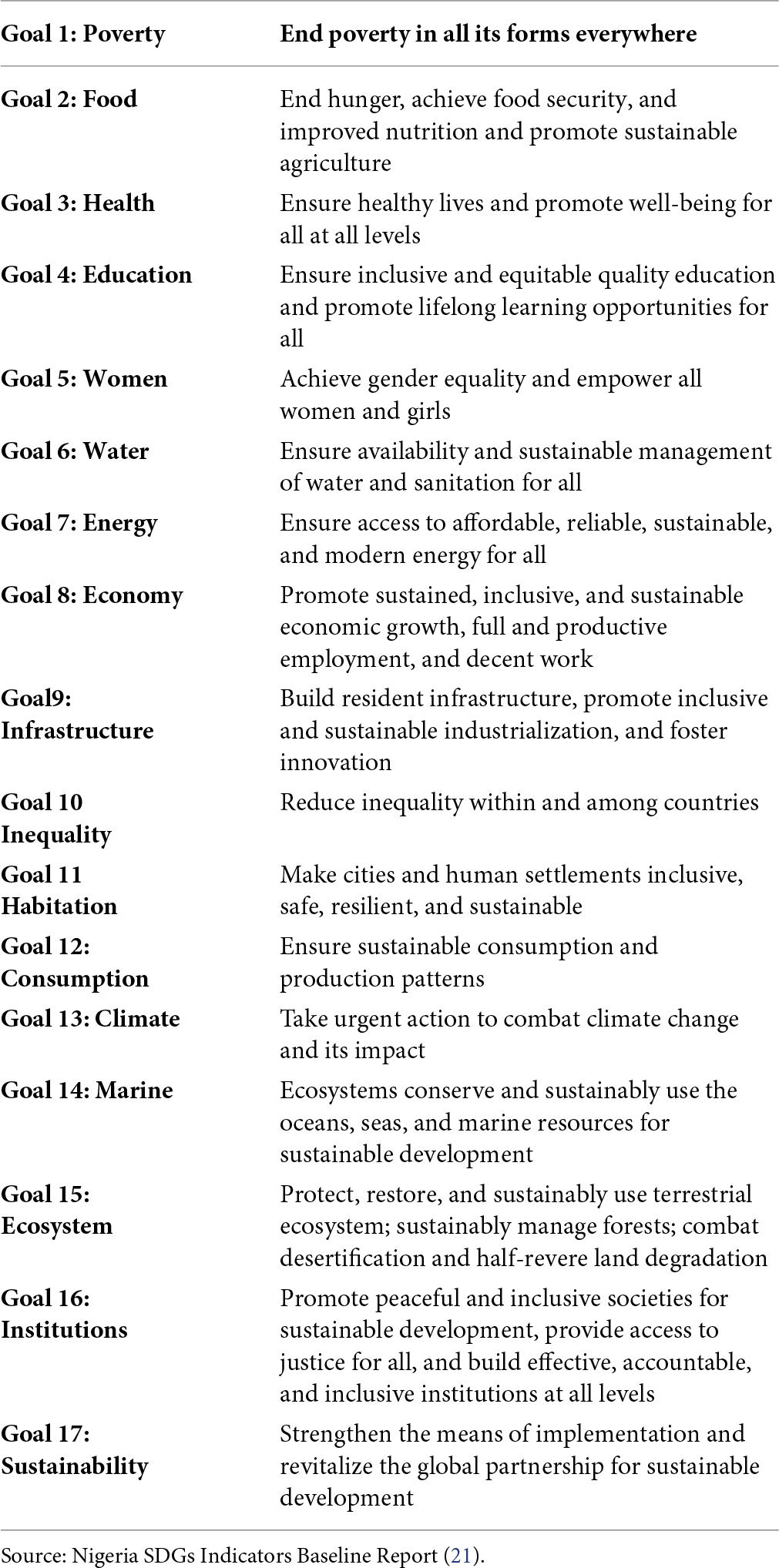
Table 1. The sustainable development goals.
Table 2 demonstrates that the small number of female vice chancellors at Nigerian institutions can be attributed to the general lack of women at the highest executive levels of the system. It can be challenging to support a successful profession while also juggling parenthood, family responsibilities, and other commitments. The survey also found that one of the barriers to more women becoming vice chancellors in Nigeria’s public universities was weak lobbying power in a complex, male-dominated system. The politics surrounding the vice chancellor’s appointment have evolved into a struggle that demands more from the majority of eligible female candidates.
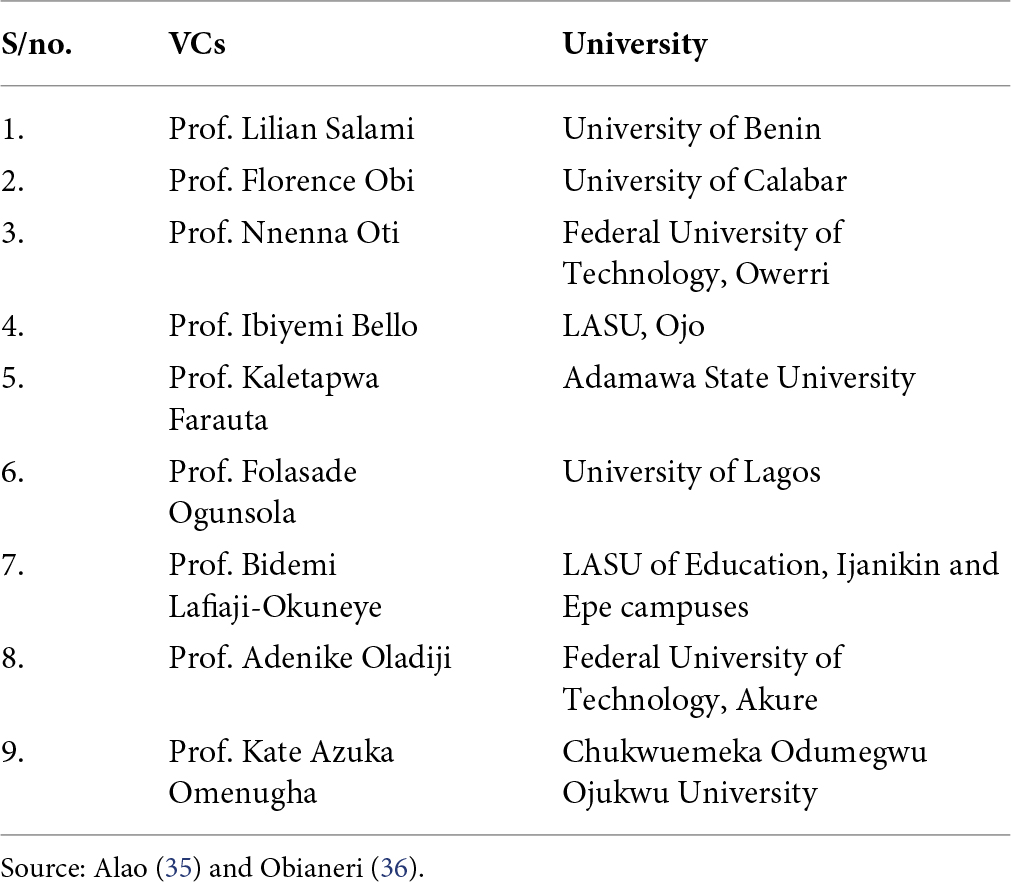
Table 2. Nine female VCs in Nigeria.
The Nigerian democracy has been marked by significant lopsidedness and favoritism in addition to high levels of corruption, and the academic environment is not exempted. Traditionally, most female academics may not have the courage or resources to face such rigors; external influences typically play a bigger role in the appointment of VCs. The implication is that women will continue to be excluded significantly even if fewer of them do not meet the requirements for such highly corrupt systems as the one in question (37).
Due to gender roles, discrimination against women is common. Many firms want to work with males who won’t miss work because of obligations to their families. For instance, if her infant becomes ill or if she experiences morning sickness while pregnant, the lady may miss work. She could also request maternity leave or take time off to visit pregnancy appointments. All of these elements combine to lower the quantity of jobs available for women (38). A few structural obstacles faced by ambitious female leaders in colleges include sexism, misogyny, and a culture that is unfriendly to family responsibilities. Only 34.7% of senior positions in Nigerian businesses are held by women, compared to 65.3% by men (39).
Women in Africa are persistently underrepresented in local and national institutions and have little influence over decisions that directly impact them (40, p. 152). Gender disparities reinforce power imbalances and restrict women’s engagement. Their ability to fully participate in leadership positions in society is constrained by their limited access to formal education, and occasionally their open denial of it.
How can programs for gender sensitization in university settings change the prevalent mindset concerning gender bias in Nigerian universities?
Gender sensitization is the process of making people more aware of the issues surrounding gender equality. People who have been gender sensitive have a better understanding of the distinction between sex and gender, how gender is socially produced, and gender stereotypes (41). In these turbulent times, gender sensitization is crucial. In the family, workplace, and community, both men and women perform important roles. It is crucial that both feel respected in society and live graciously. It is crucial for universities to have female leaders. They are powerful forces that help to strengthen gender balance and change agents that can influence decisions and policies that affect women (42). According to Ritt (43), women are more inclined than men to support policies that advance women’s interests and boost their participation in leadership positions.
The study clearly stressed the need for management of Nigerian universities to carry out a sensitization policy’s mission of guaranteeing at least 30% of women’s representation in leadership roles and committees based on the results of the data from Table 2 above. The process of bringing about such management knowledge would serve as motivation to boost the representation of women in committees in order to achieve SDGs 5:5. This is crucial because management requires feminist knowledge within the university’s managerial competence. A modest step in this regard will be taking committees whose job it is to mainstream gender by educating the university community. The report reiterates the requirement to create gender officers in significant administrative units to oversee gender equity concerns in order to further actualize this.
The university management expects the gender officers to regularly report on the status of women and other efforts to advance gender equality. It is important to remember that the university’s gender policy should require the usage of networks of gender focal points throughout all faculties, departments, units, centers, and institutes within the university system, but the document doesn’t appear to have adequately implemented this idea. The study observed that although some universities have institutionalize gender centers and study centers, the gender policy seems not to have been fully felt in some universities in Nigeria, which includes the University of Benin, Benue State University, Bayero University, Kano, the University of Port Harcourt, the University of Nigeria, Nsukka, and Obafemi Awolowo University, Nigeria. In this regard, Timmers et al. (44) noted that most universities in Sweden create committees to support the institutionalization and promotion of gender policy initiatives and activities, thereby creating awareness of the document.
The study also stressed the necessity of holding leadership development workshops for female employees as a means of promoting them to management roles. The career opportunities in terms of development, capability, and skill acquisition necessary to fit into leadership positions will be greatly impacted by leadership programs. Leadership development is a crucial step toward success, particularly in the context of higher education, as it teaches women how to “play the game.”
Pitts (45) discovered comparable outcomes. The gender policy is generally viewed as having a lower priority in Nigerian universities, and the community is not aware of the document’s analysis of the admirable implementation plans, nor have they been implemented as they ought to be. Generally, these mindsets resonant with the fact that the gender policy is a lower priority in Nigeria universities and the document’s analysis of the laudable implementation strategies is not known to the community, nor have they been activated as should be.
Conclusion
Leadership is essential for improving university performance, and a leader’s efficacy and ability to inspire followers to reach objectives are greatly influenced by his leadership style. Even if there are a significant number of women in academia, men still hold the majority of leadership roles at institutions. Although there is a presumption that women’s underrepresentation in leadership roles can be explained by the fact that their leadership styles differ from those of men, this study has demonstrated that, despite the gender gap, women can lead just as effectively as men.
The study pointed out that gender inequality and job discrimination are strongly correlated. Tiwari et al. (46) discovered that gender-based stereotypes and prejudices are the basis for workplace discrimination against women, which is consistent with the findings of the current study. Therefore, it is claimed in this study that the university is a patriarchal and masculinized institution where men predominate in positions of authority. The study has shown that gender diversity is a result of a variety of issues, including culture, self-inflicted stereotypes, and system disproportionality, as well as typically low female numbers and low drive to canvass or take up leadership positions.
Recommendations
The following recommendations are proffered for the study:
The study recommends that governments and stakeholders adopt a gender-responsive approach to governance, service delivery, education, development, and civic engagement aimed at addressing all forms of gender inequality towards the achievement of SDGs 5:5. The research furthermore, recommends that the university governing councils should make policies that will guarantee equitable female representation in leadership positions. In order to address all types of gender inequality and advance SDGs 5:5, the study recommends that the government and stakeholders embrace gender-responsive approaches to governance, service delivery, education, development, and civic participation. Additionally, according to the findings, university governing boards should adopt regulations that would ensure that women are fairly represented in senior roles. The idea that women are at the mercy of men needs to be forcefully challenged by wives, husbands, fathers, employers, and the government.
Limitations of the study
The study has a few limitations. First, studies exploring the gender and leadership gap in Nigerian universities regarding SDG 5 (Gender Equality) are often constrained by a reliance on qualitative, secondary data rather than broad empirical validation, limiting generalizability. Key limitations include focusing on specific regions or institution types, the impact of patriarchal cultural norms, and insufficient data on the intersectional barriers (such as age, location, and funding) that hinder women in academia. Second, focusing on geographical and institutional scope is very important. Studies are often localized to specific universities or states (e.g., in Abuja or a particular region), making it difficult to apply the findings to the entire, diverse Nigerian university system. Third, there is a noted lack of comprehensive, up-to-date data on the exact number of women in specific leadership roles (VCs, deans, and senate members), making precise tracking of SDG 5 progress difficult. Four, studies frequently treat “women” as a homogeneous group, often failing to analyze how socioeconomic status, religion, and geographic location further compound leadership disparities. Despite these limitations, this study has contributed to the literature on gender and leadership concerns within universities in Nigeria and demonstrated that policy interventions may need to consider socio-cultural differences across geographical locations.
Funding
This research received no specific grant from any funding agency.
Acknowledgments
The author appreciates the reviewers for their useful suggestions and comments.
Conflict of interest
The author declares that the research was conducted in the absence of any commercial or financial relationships that could be construed as a potential conflict of interest.
References
1. News Agency of Nigeria (NAN). The NPC Drums Support for Women Empowerment, Gender Equality. The Guardian Nigeria (2022). Available online at: https://guardian.ng/news/npc-drums-support-for-women-empowerment-gender-equality/ (Accessed August 10, 2023).
2. Eurostat. SDG 5 - Gender Equality: Achieve Gender Equality and Empower All Women and Girls. Eurostat (2023). Available online at: https://ec.europa.eu/eurostat/statistics-explained/SEPDF/cache/63333.pdf (Accessed September 10, 2023).
3. George AS. Bridging the gender gap in STEM: empowering women as drivers of technological innovation. Partners Univ Innov Res Pub. (2024) 2(2):89–105.
4. Zhang C, Basha D. Women as leaders: the glass ceiling effect on women’s leadership success in public bureaucracies. Gen Manag Int J. (2023) 38(4):489–503.
5. Bothwell E. Female Leadership Advances Slowly in World’s top Universities. Times Higher Education (2017). Available online at: https://www.timeshighereducation.com/news/female-leadership-advan ces-slowly-in-worlds-top-universities
6. Forestier K. Manifesto for Change’ for Women in Higher Education. University World News (2013). Available online at: https://www.universityworldnews.com/post.php?story=20130313132344590
7. Morley L, Crossouard B. Women in Higher Education Leadership in South Asia: Rejection, Refusal, Reluctance, Revisioning. British Council (2015). Available online at: https://www.britishcouncil.org/education/he-science/knowledge-centre/national-policies/report-women-higher-education-leadership-south-asia
8. Morley L, Crossouard B. Women’s leadership in the Asian century: does expansion mean inclusion? Stud High Educ. (2016) 41(5):801–14. doi: 10.1080/03075079.2016.1147749
9. Zvavahera P, Chirima. Flexible work arrangements and gender differences in research during the COVID-19 period in Zimbabwean higher learning institutions. Perspect Educ. (2023) 41(1):4–18. doi: 10.38140/pie.v41i1.6300
10. Calderon A. The proportion of women in academic leadership is on the rise. Int High Educ. (2023) (114).
11. Mabokela RO, Mlambo YA, Eggins H editors. Women, leadership, and organizational culture in higher education: lessons learned from South Africa and Ghana. The Changing Role of Women in Higher Education. Basel: Springer (2017). p. 75–92.
12. Anietie E. Nigeria Risks Falling Further Behind on Women’s Equality. Human Rights Watch (2022). Available online at: https://www.hrw.org/news/2022/03/08/nigeria-risks-falling-further-be hind-womens-equality (Accessed August, 20, 2023).
13. Nuhu S. Nigeria Improves on Gender Equality — Report. Premium Times (2019). Available online at: https://www.premiumtimesng.com/news/more-news/369274-nigeria-improves-on-gender-equality-report.html (Accessed August 15, 2023).
14. Chigbo M, Tartsea-Anshase M. The Place of Gender in Social and Symbolic World. Guardian (2022). Available online at: https://guardian.ng/politics/the-place-of-gender-in-social-and-symbol ic-world/ (Accessed August 20, 2023).
15. Holstein JA, Gubrium JF. Active interviewing. In: Holstein JA, Gubrium JF editors. Postmodern Interviewing. Thousand Oaks, CA: Sage (2003). p. 67–80.
16. World Health Organization. Gender and Health. World Health Organization (2023). Available online at: https://www.who.int/health-topics/gender#tab=tab_1
18. Udegbe B. Leadership: nature and pathways to effectiveness. In: Udegbe B, Balogun S, Osinowo H, Sunmola G , editors. Psychology: Perspectives in Human Behaviour. Journal of the Department of Psychology, University of Ibadan (2005).
19. World Bank. Construction Knowledge Societies: New Challenges for Tertiary Education. Washington: World Bank (2002).
20. UN Secretary-General. The Sustainable Development Goals Report. (2016). Available online at: https://unstats.un.org/sdgs/report/2016/
21. Nigeria SDGs Indicators Baseline Report. Nigeria: Sustainable Development Goals (SDGs) Indicators Baseline Report 2016. United Nations Development Programme (UNDP) (2016). Available online at: https://www.undp.org/nigeria/publications/nigeria-sdgs-indicators-baseline-report-2016 (Accessed August, 6, 2023).
22. Olugbemi B. Nigeria and the Sustainable Development Goals. BusinessDay (2020). Available online at: https://businessday.ng/columnist/article/nigeria-and-the-sustainable-development-goals/#google_vignette (Accessed September 3, 2023).
23. Anger J. Her Protection of Women. StudySmarter (1589). Available online at: https://www.studysmarter.co.uk/explanations/politics/political-ideology/radical-feminism/ (Accessed August 23, 2023).
24. Echols A. Daring to be Bad: Radical Feminism in America 1967–1975. Minneapolis: University of Minnesota Press (1989).
26. Johnsen G, McMahon R. Owner manager gender, financial performance and business growth amongst SMEs from Australia’s business longitudinal survey. Int J Small Bus. (2005) 23(2):115–42.
27. O’Oconnor K. Gender and Women’s Leadership: A Reference Handbook. London, UK: Sage Publications (2010).
28. Iniobong I. Meet Female Lawmakers in Nigeria’s 10th National Assembly. BusinessDay (2023). Available online at: https://businessday.ng/politics/article/meet-female-lawmakers-in-nige rias-10th-national-assembly/ (Accessed August 12, 2023).
29. Morley L. Women and Higher Education Leadership: Absences and Aspirations. London, UK: Leadership Foundation for Higher Education (2013).
31. Williams A. Fear of Stigma Lingers About Use of Family Friendly Policies. The Chronicle of Higher Education (2014).
32. Okunola P, Uzoka N, Adetoro J, Sule S. Determinants of female participation in university governance in Nigeria. Malays Online J Educ Manag. (2017) 5:1–15.
33. Aladekoye O. Nigeria’s Universities Surge to 300: Private Sector Drives Growth amid Quality and Oversight Challenges. The Nigeria Education (2025). Available online at: https://thenigeriaeducationnews.com/ 2025/07/21/nigerias-universities-surge-to-300-private-sector-drives-gr owth-amid-quality-and-oversight-challenges/
34. National Universities Commission (NUC). Nigeria Now Has 300 Universities as NUC Approves Ebonyi State’s Specialized University.National Universities Commission (NUC) (2025). Available online at: https://business247news.com/2025/07/11/nigeria-now-has-300-universities-as-nuc-approves-ebonyi-states-specialized-university/
35. Alao A. Eight Female Vice-Chancellors in Nigeria. The Nation (2023). Available online at: https://thenationonlineng.net/eight-female-vice-chancellors-in-nigeria/ (Accessed September 5, 2023).
36. Obianeri I. Anambra Varsity Staff Urge Soludo to Name New VC. Punch Newspapers (2025). Available online at: https://punchng.com/anambra-varsity-staff-urge-soludo-to-name-new-vc/
37. Kurga GK. Understanding Gender Diversity in Nigerian Public University Leadership: A Focus on Vice Chancellor Position. Master Thesis, Malno University (2022).
38. Kenechi S. 202 Nigerian Varsities, 11 Female VCs — Case for Gender Inclusion in HE Headship. TheCable Lifestyle (2021). Available online at: https://lifestyle.thecable.ng/202-nigerian-varsities-10-female-vcs-case-for-gender-inclusion-in-he-headship/ (Accessed September 4, 2023).
39. National Bureau of Statistics. Statistical Report on Women and Men in Nigeria. National Bureau of Statistics (2016). file:///C:/Users/user/Downloads/2015%20Statistical%20Report%20on%20Women%20and%20Men%20in%20Nigeria_final.pdf (Accessed August 27, 2023).
40. Eze OC. Human Rights in Africa: Some Selected Problems. Lagos, Nigeria: Macmillan Nigerian Publishers (1984).
42. Schwartz SH, Rubel T. Sex differences in value priorities: cross-cultural and multimethod studies. J Person Soc Psychol. (2005) 89:1010–28.
43. Ritt E. Hearing the opus: the paradox for women leaders in the postmodern universities. Adv Women Lead J. (2004) 16:35–48.
44. Timmers T, Willemsen T, Tijdens K. Gender diversity policies in universities: a multi-perspective framework of policy measures. High Educ. (2010) 59(6):719–35.
45. Pitts DW. Implementation of diversity management programmes in public organizations: lessons from policy implementation research. Int J Pub Admin. (2007) 30(12–14):1573–90.
46. Tiwari M, Mathur G, Awasthi S. Gender-based discrimination faced by females at workplace: a perceptual study of working females. J Entrep Educ. (2018) 21(3):1–7.
© The Author(s). 2026 Open Access This article is distributed under the terms of the Creative Commons Attribution 4.0 International License (https://creativecommons.org/licenses/by/4.0/), which permits unrestricted use, distribution, and reproduction in any medium, provided you give appropriate credit to the original author(s) and the source, provide a link to the Creative Commons license, and indicate if changes were made.